2017 COMMENTARY OF THE INTERNET PUBLICATION OF ANDRES PÄÄBO
and
an Introduction with Reproduction of the Content Pages
THE VENETIC
LANGUAGE
THE VENETIC LANGUAGE: An Ancient Language from a New Perspective: FINAL
The ancient inscriptions found in northern Italy has been a mystery for centuries. But in the last half century, scholars have been devoting much time and effort to trying to decipher them, to learn what they say. Because the writing used an alphabet adopted from the Etruscans and modified, in the beginning scholars thought the Venetic language might be similar to Etruscan. Later, scholars thought the language was Illyrian. Finally scholars decided perhaps Venetic was an early form of Latin. Because Latin is well known, many scholars rose to the challenge of trying to find Latin inside the inscriptions. But the Latin hypothesis has not had much success either. In order to find Latin-like sentences in the Venetic inscriptions, scholars had to imagine many puzzling sections of the inscriptions were proper names of the deceased, his relatives, or dieties. Pushing Latin into the Venetic inscriptions produced some results, but the Latin hypothesis was not causing scholars to leap for joy. Because of the uninspiring results, it inpired new theories like the one that came from some Slovene scholars. Slovene-speaking scholars began to wonder if the Slovene langauge itself was descended from Venetic. The Slovene hypothesis was born. But the Slovene hypothesis has not been as smooth as expected. There is no word list, no grammar and sentences seem absurd to archeologists. The Slovene hypothesis like the Latin hypothesis has made very slow progress and leads to great amounts of discussion and debate. The results have never been convincing enough for the matter to be settled - for everyone to agree that the Venetic language has been discovered. Instead, the followers of the Slovene hypothesis ridicule thetraditonal academic approach for producing empty sentences - like what one sees today on tombstones and memorial plaques - mostly proper names. And on the other hand, the academics who believe they have followed good linguistic analysis, ridicule and ignore the Slovene analysis for having no methodology at all - amateurishly simply trying to hear vague Slovene sentences in the Venetic inscriptions in much the same way a religious monk might hear God speak to him through whispers in the sounds of the wind.
Into the middle of this conflict, stepped Andres Pääbo, who used neither method. He approached the inscriptions like an archeologist does - studying the objects on which the inscriptions were written, and their context in the archeological finds. Because all the Venetic sentences were written in short sentences on objects with clear purpose and context. By putting himself into the mind of the Veneti, he would be able to understand what the inscription probably says, and probably does not say, and that would serve as a guide to decisionmaking. He describes his methodology in great deal in the book.
Andres
Pääbo did his interpreting from two major books that catalogued
the inscriptions including illustrations and descriptions of their
context in the archeology. After a few years he documented what he
found and created a book in the form of a pdf document. He placed
the 2006 publication on the internet in order to recieve
feedback. The response was sometimes vicious. Followers of
the Slovene hypothesis simply could not accept this new enemy to
their hypothesis appearaing out of nowhere. While a few critics were
openminded, and tried to explain why Pääbo was achieving good results,
easily, others were so upset that they could not think of any other
reaction than to try in all means possible to ridicule the new "Finnic
Hypothesis" and even to verbally mock Pääbo personally in public
"commentary".like Anthony Ambrozic. In fact Pääbo is a cool scientific
person who had found a methodology that permitted the inscriptions to
reveal themselves . This methodology could have lead the results
towards another language, but it progressed towards looking
increasingly like a Finnic language, carried down from the north by
ancient amber trade. This allowed additional use of Estonian and
Finnish to confirm results - as an additional check.
Since 2006, Pääbo continued to expand the book, and make it better organized, He added more work on determining Venetic lexicon and grammar. Anyone truly interested in the mysterious Veneti, has to investigate what Pääbo has done, to decide for themselves the validity of the work.
The following presents the issues that has arisen in this political climate of trying to identify the Venetic language in the form of a debate between three people: one understands Pääbo's hypothesis, who we will call PRO, and one who follows the Slovene and/or Latin point of view, who we will call ANTI, and a third who will be the MODERATOR. The questions and answers are developed around the most common ones that have arisen since the first publication of Paabo's book and theory in 2006
MODERATOR: The most common objection to Paabo's perspective, is that he proposes that Venetic was a Finnic language. Let us begin there.
ANTI: Scholars say that FInnic people did not arrive at the Baltic until a little before Roman times. How could Venetic inscriptions be Finnic?
PRO: The theory that the Finnic languages arose at the Ural Mountains and then migrated west in steps, with linguistic divergence at each step, was concieved a century ago before there was much information from archeology and other sciences, and the theory was created by linguists who were not even qualified to interpret their results. Linguistics can only analyse languages and determine how one language changed into another, and how two languages could have had a common parent, and so on. Thus the linguistic tree diagram of relationships between languages could be correct, but the entire idea of where it began, migrations, etc is not provided by linguistics - the interpretation and explanation has to be done outside of linguistics by archeologists and other sciences. The Uralic languages theory has been debated in Finnic scholarly circles since the 1960's. By about the 1990's the original theory had been modified to keep the migrations idea, but push the time of arrival back to the archeological "Comb Ceramic Culture" of around 5000 years ago. Any notion of Finnic language arriving only around Roman times, is misinformed and a reversal back to the original. The century-old idea tends to survive in literature outside Finnic languages and scientists who do not do their research will find it in their books, and not realize that these ideas are now discredited by sciences like archeology, and been replaced.
ANTI: But the new population genetics has determined that a Y-DNA N-haplogroup has migrated from the Urals westward to the Baltic and arrived at the Baltic only about 2000 years ago, agreeing with the linguistic theory.
PRO: This could simply be a matter of the population geneticist being ignorant of the story behind the original Uralic Languages Family, and unaware of the debate going on to make the story agree better with all sciences. Even so, all scientists who speak about migrations west from the Urals, completely ignore the reality that there were, by 11,000 years ago, peoples already established throughout the region between the Baltic and Urals. Archeology has determined that at the end of the Ice Age, when the land was flooded with glacial meltwater, boat-using hunter gatherers developed, and that they quickly followed waterways like the Volga to the Urals and archeological findings like the Shigir statue found in the remains of an ancient bog, prove that European boat peoples were at the Urals at 11,000 years ago, and also that the middle Ural Mountains had reindeer hunters of Asian origina, probably the original carriers of the N-haplogroup. What really happened, then, was tha after this contact between these two groups, a mixing began, and what migrated was not people, but INFLUENCE. The N-haplogroup diffused westward and so did the Urals Mountains language. The DIFFUSION could have reached the Baltic only by the Roman Age, but a Proto-Finnic boat people language could already have been esablished at the Baltic 12,000 years ago.
ANTI: Yes, I agree, any migrations theory has to involve interractions with peoples already along the migration path and at the destination, and that means there is influence, mixing. The diffusion of the new characteristics into the old, without there being any designed migration of a group.
PRO: Everyone seems to be making a fundamental error - treating the original boat peoples as if they suddenly vanished, and a new people, language, genes moved into that territory. Obviously if there already exist a people in an area, you cannot ignore them. They have a language and that language is influenced (adopting new words, for example) Imagine puttina a drop of blue dye in a bowl of water in 12,000 years ago, and soon the water is blue and then put a drop of red dye coming in from an edge, and the red dye begins to spread, the closest blue water becomes a strong purple and the purple is weaker further away from the source, until furthest away the red is so weak te blue water is unchanged. So imagine the blue water represents the boat peoples at around 11,000 years ago, and the red dye is introduced about 10,000 years ago, and it spends many millenia diluting westward. It doesn't matter when the purple arrives at the Baltic. The blue from the boat peoples has always been there since 12,000 years ago.
MOLDERATOR: Let us not go off topic. Paabo's interpretation of Venetic inscriptions was not dependent on any historical or prehistorical story.The history and pre-history of the Finnic boat peoples, is a separate thousand page book all to itself. The timing of arrivals of migrations or diffusions at the Baltic can be irrelevant. If the Finnic language was still in the Volga, for example, it could have travelled down the Volga and explain the "Eneti of Paphlagonia" or archeology finding Baltic amber in tombs of Babylon dating to before 5,000 years ago. We should not pay too much attention to geographical locations of source Finns. After all Hungarian has a language closest to the Finno-Ugrians of the Ob River up in Siberia. Who knows, Venetic could have been a language that preceded Hungarian, not far north from the Adriatic Veneti location.So we should depart from that question and deal with the Venetic inscriptions, which Paabo claims he interpreted directly from the archeological objects contexts and internal back-and-forth analysis. So let's look specifically at what the book and theory is about, and leave the historical and prehistorical theories for a separate book for another author another time.
PRO: Yes, the whole story of prehistorical Europe is a completely separate story that does not affect the project of deciphering the inscriptions. Paabo's methodology indeed does not begin by assuming a connection to Estonian or Finnish. He goes off on tangents probably for his own speculations. The book actually begins by interpreting the archeology directly, just like a deaf person learns much of a language from observing the use of signs and labels in a grocery store. But of course, once the FInnic nature of Venetic becomes obvious, references can be made to Estonian for further help.
ANTI: Alright, we can leave the historical reconstructions to the prehistorians. Let us speak about language. Let us speak about evidence of FInnic at the Adriatic. If Venetic was Finnic, how does Paabo explain all the toponymic evidence of an old Slavic type of language in the mountains of the north Adriatic region?
PRO: Two peoples, two languages, can coexist in the same area. Paabo proposes that the Veneti were trader peoples, much like the Phoenicians, except the Veneti travelled the large rivers through Europe - Loire, Elbe, Rhine, Danube, and so on - and of course east-west across the northern seas. If we use the Phoenicians as an example, the Phoenicians created colonies in numerous places along their routes along the south coast of the Mediterranean, in the Iberian Peninsula and south along the African coast. They established their colonies among settled peoples speaking a different language. The Phoenicians spoke a Semitic language. The settled peoples actually welcomed trader colonies, as settled peoples were stuck in one place, while the long distance traders brought exotic goods from afar. So Paabo's view of the north AdrIatic Venetic peoples was that they had created colonies at the termnals of major rivers, If you look closely Venetic cities are all along the rivers descending to the Adriatic. They were not mountain people. On the other hand, the settled peoples of the region were those who inhabited mountains and valleys, and tended to herds of goats, sheep and cattle. That is how you have to look at it.
ANTI: The Slovene theory has not given much attention to the ancient world of trade, even though there is plenty evidence in archeology and ancient history of how Veneti were conduits for both amber and tin 'from the end of the earth'.
PRO: The discussion about the role of ancient trade to the creation of civilization has not happened. Today we take it for granted. We get fruits in our grocery store that came by ship from another continent, and do not think of how significant it is, and so if in early Europe there were northern aboriginal peoples who had nomadism in boat in their blook since the ice Age, they would have easily moved into the role of being the professional traders and shippers of early European civilization.
ANTI: Scholars say that the Urnfield Cultures, found scattered around Europe, were the result of random migrations of Venetic farmers, but it makes more sense they were nodes of a large scale trade network
PRO: Exactly. But the large networks of both the Phoenicians and Venetic came to an end with the rise of the Roman Empire. Venetic colonies melted into their language and culture of their local settled peoples. In Brittany the became Celtic-speaking, between the Baltic and Black Seas, they became West Slavic speaking, between the Baltic and the Adriatic they became Slovene-speaking, and of course in northern Italy they became Latin-speaking. If the Phoenicians colonies melted into their surroundings, then the Venetic colonies did too. There was a major Phoenician colony in Spain. Before the Roman Empire screwed up the original Europe, they were all speaking their Semitic Phoenician. I see absolutely no problem in claiming there was an original ancient Venetic language covering early Europe, which then was broken up by developments adter the Roman age. There is just alot of evidence of early peoples becoming assimilated as a result of the five centuries of the Roman Empire.
ANTI: If the Veneti were everywhere in Europe, using large trade system, then by your theory, they evidence of the large scale system should be found everywhere in ancient place names.
PRO: Yes, but obviously along the trade routes and around the nodes. And the settled peoples between these trade routes -in hills and mountains - could have been speaking a different language. For example, in Western Europe there could have been Venetic-like dialects in the major waterways, but the settled peoples between the water routes could have been Cetlic or something else. My approach does not conflict with the Slovene or Celtic scholars finding Indo-European languages in the lands between the major trade routes.
ANTI: So we do not have to consider a FInnic Venetic to be in conflict with Slovene theories about European origins.
PRO: No. But that also means that you have to expect that toponymic analysis will also find Finnic Venetic names associated with waterways, etc alongside the major trade routes, and this should not be surprising. . By identifying the trade routes, we can find the Finnic words, and by identifying the regions with the settled peoples, we can find the settled people language. For example the Loire language was called Liger by the Romans, which was LIGERA, which can be interpreted with Finnic as LIIGE-RA 'moving-way'. Looking into the mountains, we will not find FInnic words anymore, but Indo-European ones, or some kind of hybrid between the two.
ANTI: Alright. When Paabo first came out with his book, everyone assumed he had simply tried to find Estonian sentences in Venetic. But he did not use that approach. Let us speak about that. Let's get back to the language deciphering that the book as all about.
PRO: According to Paabo's lengthy prefaces, he was already somewhat knowledgable in linguistics, and how linguists ridiculed the way amateurs were attempting to discover their language in toponymy by discovering similar words in their language. He had also noted that past interpreting of the Venetic using more or less this approach, had not solved the problem. He could have tried to project Estonian onto Venetic, but he was determined to find a better, more scientific methodology. He used the methodology already at the start, but because he also consulted Estonian (Consulting is not the same as forcing Estonian onto Venetic) all readers ASSUMED in 2006 he had simply looked for Estonian in the Venetic. So that is why in his FINAL version, he spend a third of the book describing the project and its methodology in detail. As you see, he deciphered the Venetic directly from context for as far as he could go, and when it was clear it was Finnic and he could see the ways in which Venetic differed from Finnish and Estonian - such as being less rounded, more palatalized - he was able to use Estonian and Finnish to refine the whole thing. He could then apply linguistics too. You can read about it in detail,
ANTI: So he applied linguistics too? That is new to me.
PRO: According to Paabo, the reality is that before you can analyze a language with linguistics you have to discover it. If for example,someone finds an unknown language in a South American jungle,. a linguist has to live among the people and learn the language from experiencing it in actual use. It is only when at last some of the language is discovered, that the linguist can begin to appy linguistic wisdom. Of course, in practice, usually the linguist finds a translator (usually called an informant), who konws both the linguist's language and the language of the tribe - as a result of his or her own experience learning both languages. Therefore, the first challenge in deciphering is to discover the language. An easy way is to find the informant - in archeology that would be like archeology discovering Venetic sentences with accompanying translations in a known ancient language like Greek, Phoenician, Roman etc. The translation can then be compared to the unknown Venetic and a few words and grammatical endings discovered. Another way is to discover that Venetic is related to a known language. That works only if you can confirm for certain that the known language is REALLY related to Venetic. If the hypothesis is false then - since humans can imagine a sentence in the sounds of the Venetic - the results will be false. The third way, which Paabo relies on in order to make sure he does not waste time forcing a false hypothesis, is to behave like a deaf person in a grocery store learning the language on grocery items. He puts himself in the mind of the Venetic person in the situation in which the inscriptions are written and used. All these methods will discover the language, according to the skill of the analysts, But in all cases, once the language has been discovered, at least partially, linguistics has something to analyze.
ANTI: Linguistics does not need a complete language to study?
PRO: It needs something. Otherwise a language is only alot of sounds. Without having some word meanings and grammatical functions, linguistics only sees phonetics.Linguists can detect repeated patterns and it can help identify words and grammatical endings, but it cannot translate. The actual translating relies on getting those meanings. It is like sleep experiments - the sleep scientists can tell from brainwave activity, when the subject is dreaming, but to determine what the subject is dreaming about they have to wake him up and ask. So yes, linguistics is important, but it is a separate thing applicable only once we have discovered at least some language, and it is not just sounds. Linguistics principles include finding consistency - word stems always mean the same, grammatical endings always work the same way, and if comparing Venetic to Estonian, there has to be consistency in the way Venetic and Estonian are shifted from each other. I recall he noted that where Estonian used a D in a particular location, it became a J, or that an H became a palatalization, that sort of thing. I guess he could have continued finding such shifts if only there were more Venetic sentences. We are talking about less than 100 complete sentences and many are Roman era inscriptions on urns, that are mostly just abbreviations, like today a gravestone has R.I.P. instead of actual words. When it comes to Venetic inscriptions, the number that can be used is far too small to take any analysis to the point of reconstructing normal everyday conversation.
ANTI: So deciphering is not about linguistic analysis?
PRO: No. Linguistics is one of many tools. According to Paabo, deciphering is just like anyone experiencing a language he or she does not know, and learning it by watching it in action. If the language is only in written form, same thing - you experience how it is used on signs, packages, newspapers, etc And if we are speaking of the past, and archeology reconstructs ancient sites, then it is possible to some extent to also interpret what the ancient writing probably says. For example a word above a doorway to which ancient women went to the washroom, probably meant 'women'. You don't need too much information this way, because you can then also compare words in different locations. For example a sign above a bin of apples that seems it should mean 'apples' can be confirmed to mean 'apples' of the same word is found on a jar of apple sauce. I think a grood Venetic example was to narrow down on the meaning of .e.go by noting that it did not have to be connected to a death, so it simply meant 'let remain, rest'. This kind of back and forth across all the archeological sites and all the archeological objects and all the inscriptions, can reveal a great deal that allows the decipherer to 'crack' the code.
MODERATOR: Enough about Paabo's methodolgy. Anyone can learn about it in detail in Paabo's book, which goes into great detail about it - a whole third of the book. Let us now address the two competing methodologies and results - the academic world interpreting Venetic inscriptions with an assumption Venetic was Indo-European in Latin-like manner, and the newer Slovene hypothesis that the ancient Venetic language was Slavic, just like the south Baltic Venedi language was in the post-Roman period.
PRO: I think the Slovenes having an interest in their history, saw that in the centuries after the Roman Empire, history was characterizing the Venedi in the region that is now Eastern Europe as Slavic, and because Slovenia was close to the region where inscriptions of the Venetic language were found, they simply projected something that was true in historic times, backwards to before Roman times and to the ancient inscriptions. They were there, so why not propose that hypothesis. It is as simple as that. Of course in reality, the Adriatic Venetic inscriptions were found in northern Italy, and what were the Veneto Italians northwest of Venice to think of arrogant Slovenes claiming that the inscriptions right there in their countryside were Slovenian-like? How did Slovenians have a greater right to the ancient Veneti than they? Scholars had already decided that the Adriatic Veneti inscriptions were Latin-like, ancient Latin, ancestral to the Romans. A political drama was created around the Adriatic Veneti and Paabo walked right into the middle of it around 2006.
MODERATOR: So supporters of Paabo, will have an opinion about both interpretations. Let us begin with the scholarly approach which used Latin and Indo-European linguistics. PRO?
PRO: The traditional world of scholarly studies has the problem that it can dig itself into a hole from which it is difficult to get out. That's for example the case with the Uralic Languages Family theory invented a century ago that saw all those migrations from the Urals mentioned earlier. Even though everyone outside linguistic institutions can see it is erroneous, or at least extremely flawed, a whole century has passed and it is still in place because departments of linguistics cannot let it go. That's because the academic world builds on what has come before, so if what has come before is flawed, the flaws get propogated. So there we have someone in the 1960's deciding why not assume the Venetic inscriptions are an archaic Latin. Thousands of manhours are spent by everyone who knew Latin seeking to crack the code, So many books and papers are created and published under the auspices of universities and the departments of linguistics. It produces a great inertial mass that cannot be ignored. So universities may listen to other ideas, but are unable to change what has been established because of the great inertial mass that has developed around that area of study. But as far as what Paabo says in the book, the deciphering of Venetic with linguistics is a case of forcing a hypothesis onto the inscriptions, without the hypothesis every having been proven to be true. Indo-European words and grammar are simply being imposed on Venetic wherever it seemed to lead somewhere.
ANTI: But you said linguistics cannot analyze a language that has not yet been at least partially discovered.
PRO: However if you have already decided that Venetic belongs to a particular language family, you can not only push words on it, but also the linguistics of that particular language. Let us say that you were told that a set of ancient inscriptions were written in a language related to Latin, would you not begin to study all the inscriptions in order to look for sounds similar to Latin word stems and grammatical suffixes? Yes. If you believe that scholars have decided and confirmed that Venetic is an archaic Latin, then you will not even consider that the decision scholars made at the outset actuallyt had no foundation - it as just a hunch, a hypothesis to test. It was just a whim. And yet if you believe, then you will assume failure to get results is simply your own fault rather than the fault of the wrong hypothesis itself. With the Latin approach in the academic world, all the inertia made the hypothesis so deeply entrenched that you can see trained historical linguists investigating and finding all kinds of linguistic shifts and whatnot, and not being deterrred because they truly believe, The only way to backtrack from a hole, is to simply walk away, and not try to change the institution that created the hole.
ANTI: So now, what about the Slovene hypothesis?
PRO: It too used the method deciding arbitrarily from some circumstantial information and hopeful expectations, without ever having any real linguistic evidence, that Venetic was Slovene-like. The Slovene theory is driven by nationalism. That is their hole from which it is difficult to backtrack.
ANTI: But the Slovene theory is a comprehensive one that is mostly about the origins of Europe with Indo-European speakers, and that the Slovene language is simply closer to ancient Indo-European than other Indo-European families. The deciphering of the Venetic inscriptions is really only a tangent to that general theory.
PRO: That's great. It means The Slovene theory can allow that, just as in Spain, the Iberian natives allowed a Phoenician colony among them, the natives north of the Adriatic, similarly permitted the ancient Veneti to establish trade colonies even though they came from a completely different culture and language. As I said before, the mobile trader people and the settled farming naives could and did in ancient times, coexist, and benefitted both from the association.
ANTI: What about the fact that population genetics studies have shown that the region of the Venetic area shows no special indication of northern Veneti coming south and establishing the Venetic cities?
PRO: It doesn't take a large population. A small group can start something and then it grows. Once the original Veneti had established their colonies, many of the surrounding people could abandon their mountain valleys and join the world of the Veneti. For comparison, that is how Hungary evolved. Genetic studies show that most Hungarians are genetically south Europeans from around the region. Genetic connections in the direction from which the Hungarian culture came have been overhwelmed and diluted by the locals getting involved. Same thing with the Adriatic region. Some of the farmers came to the markets from their settlements, saw the excitement at the markets and they or their sons abandoned the mountain valleys and joined the world of trade, industry and commerce of the Veneti. Neither culture nor language is genetic. Often each follows a completely different path. This movement of genes, culture, and language between the VenetI and the indigenous peoples, makes the matter very complicated. Of course if we are identifying the Veneti according to language we can only look at the history of the language. Of course today one part is speaking the Veneto dialect of Italian, and the other part Slovene. It is obvious that the Veneto dialect developed when the original Veneti assimilated into the Roman Empire as the province of Venetia. It is equally obvious that the Venetic language, along the traditonal "Amber Route" that came south from the Danube to the Adriatic, became assimilated into Slovene if the settled people were Slavic/Slovene. Similarly the Roman Empire brought the end to all other large scale trader people, all assimilating into the peoples in the region of the colonies. Phoenician and Greek colonies of Spain and Europe (apparently Greek traders went considerably north on the Rhone) all disappeared from assimilation, Similarly Venetic colonies created at strategic locations in southwest Britain, Brittany, Germany, southeast Baltic, at the Black Sea, where Slovenia is today, and of course at the Adriatic --- they all eventually melted into the region's peoples, becoming part of the settled peoples, although continuing for a while to practice trading activities as it was in their blood. The Venetians who emerged in the Renaissance, for example showed a resurgence of the Venetic traditions with boats, industry, trade and commerce . They dominated the Mediterranean trade for centuries. It was in their blood even though they had assimilated into the Romans.
ANTI: What is Paabo's opinion regarding the Slovene theory of an original Slovene-like Europe?
PRO: Paabo suggests in his prefaces and introductions that he does not care what the settled peoples did. He sees in the ANCIENT Venetic - before the Roman Age - as being part of their own large trade network, like Phoenicians were, but strongly involved with the interior rivers like Loire, Rhone, Elbe, Danube, Vistula, Oder, etc as well as the northern seas and Atlantic coast. Just as the Phoenician language - a Semitic language - was localized to thier colonies and trade routes, so too the Venetic large scale language of Europe tended to be found along the major trade routes through Europe and the northern and Atlantic coast. It follows that a toponymic analysis will find the ancient Finnic-Venetic language where the trade routes were most active. So it seems to me that he would be fine with a theory that pictures and original Indo-European civilization, but it is incorrect, he would say, to use the name "Veneti" to describe it, because civilized peoples were settled land peoples, while the word "Veneti" comes from Finnic VENE 'boat'. a word probably originated with VEENA 'instrument of water, plus plural -D, plus genitive, giving VENEDE, '(people) of the boats' (actually used by Estonians and Finns for ALL boat using trade peoples going past their doorstep) The "Slovene" word probably is a pure coincidence. Herodutus, the ancient Greek historian wrote that the Scyths called themselves "Scoloti". The word was probably altered by Greek, and could have been SCLOVI. The word SLAV may have come from Finnic languages saying SCLOVI, and then SLOVENE would be the Finnic ending -ENE on SLOV, giving the meaning 'in the nature of a SLOV or SLAV. This is in one of the versions of his book
ANTI: So essentially, if the Slovene theory of the origins of Europe does not use the term "Veneti" for the name of the civilization, but something else, then that would be fine.
PRO: Yes, since there were two civilizations originally - the one created by large scale trade industry and commernce, and the one created by settlement and farming. The two were separate but closely dependent, as it is today. Today the international industry cannot exist without shipping and trade, as well as the permanent settled people and institutions. Of course, today, we are all situated under political nations that dictate what the national language and culture is, and today (since about the Roman Age) many different ways of life are carried out using the standard language of the nation that governs us.
MODERATOR: But let us remind ourselves that the book, THE VENETI LANGUAGE: An Ancient Language from a New Perspective, is about the language. Obviously all the issues that people have is because he found the Venetic language was Finnic. According to standard thinking, how can this be possible!??? The issues do not seem to be about his methodology or results, but the fact he showed Venetic was Finnic .
.
ww.paabo.ca
DOWNLOADABLE BOOK iS AVAILABLE
THE VENETIC
LANGUAGE
THE VENETIC LANGUAGE: An Ancient Language
from a New Perspective: FINAL
This book is the culmination of
research from 2002-2012 and several projects to document the results in
book form. The first books were misunderstood because readers saw the
project as simply projecting Estonian onto the Venetic texts just as
had been done previously with forcing Latin, Slavic, etc onto the
Venetic. My pointing out similarities to Estonian was misinterpreted as
coming up with the Estonian first and pushing it onto Venetic. It was
very difficult to demonstrate that what I had done was to decipher
Venetic directly from the raw materials and texts and that the results
HAPPENED to resonate with Estonian and Finnish. This final book I
believe succeeds in doing so. I rewrote a very detailed beginning to
show exactly how it is possible to begin with the Venetic inscriptions
in their contexts and infer meanings directly, in the same way that
today a tourist can infer that the word on a red sign at the end of the
road means 'stop'. Furthermore, although I had the results already in
2006 I needed to do more work. The only way one can prove that this
interpreting of Venetic is correct is if the grammar and word
stems can be identified and if results agreeing with the grammar and
word stems can be achieved for every Venetic sentence.
(Past interpreting has simply selected the ones that 'work' and grammar
and word stem identification over all inscriptions has been avoided).
This in the last 6 years I ensured a reasonable consistency in grammar
and word stems, and achieving results ( even if a few were tentative)
on ALL the inscriptions assembled for the study. The hard reality
is that it is impossible to prove Venetic belongs to a particular
language family in direct ways. The only way it can be proven is to
describe the Venetic language in great detail. As any scientist who
reads the book must admit, it is practically impossible for anyone to
invent such a detailed description of the Venetic language and to
come up with translations that are in such agreement with the decribed
grammar and word stems, and so suitable to the objects on which they
are written. I challenge anyone who reads the final documentation, and
then to demonstrate that it is even remotely possible to invent it
all. These days we find linguists inventing langauges for movies,
but such invention is free invention. The linguist can invent whatever
he wants that follows the patterns of human language. But what if the
linguist has to create a language that agrees with hundred or so
EXISTING texts? A scientist who understands the laws of probability
will realize that the results presented here cannnot be invented. The
following reproduces the CONTENTS of the book, so you can see what is
covered, before you obtain the full book. I invite you to download the
book whether you like the CONTENTS or not. It is filled with pictures
of the objects and the writing.
[CLICK
HERE TO
DOWNLOAD
THE BOOK
IN A PDF FILE
OF
14 MEGS ]
THE VENETIC
LANGUAGE
An Ancient Language
from a New Perspective: FINAL*
[image of Pa26]
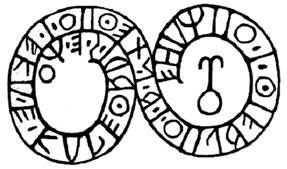
vhug-iio.i. tival-iio.i. a.n.tet-iio.i. eku .e.kupetari.s .e.go
The sentence, expanded to separate into words, is interpreted ‘let carry to eternity, on wings to eternity, the givings to eternity let-it-be, let the journey continue, let it remain’
by
Andres Pääbo
* Except this document is unpolished and unfinished in places and seeks financial support for final editing, corrections, polishing, references, etc Contact author. AP 2014
THE VENETIC LANGUAGE
An Ancient Language from a New Perspective: FINAL
by
Andres Pääbo
FORMAL EDITION - 2013
© 2006-2012 Andres Pääbo
Box 478, Apsley, Ontario, Canada, K0L 1A0
www.paabo.ca/veneti/index.html
705-656-9387
“Formal Edition” signifies the final book that has developed as a result of feedback etc from the original versions which were offered in pdf file or hand-made via laser printing to special interested people in order to gauge feedback
Credits
This work could not have been accomplished without the cataloguing of the Venetic inscriptions over the centuries, and in particular the organization of the inscriptions in the 1960’s done by G.B. Pellegrini and A.L. Prosdocimi and presented in La Lingua Venetica, and also the updated summary by M. Lejeune in Manuel de la Langue Vénète in 1974, even though both were done from a perspective based on an assumption that Venetic was Indo-European. Images used herein, other than the maps and a few other incidental images, are artistically or creatively (the author is an artist – www.paabo.ca) developed or adapted from digital shots of images presented in La Lingua Venetica In terms of references to the Estonian language strong acknowledgement is given to Johannes Aavik, A Grammatical Survey of the Estonian Language, most readily found within Estonian-English Dictionary complied by Paul F. Saagpakk, 1982.
2012 addition: The revision and improvement of this book could not have been achieved without both positive and negative responses to it. Positive responses gave me encouragement while negative responses gave me determination to try to communicate better my methodology, especially to demonstrate that there is no linguistics involved – since I am not a linguist – but that it was written from basic analysis. The additions to this book are those that were worked out in my second book The Veneti Language: A Deciphering of an Ancient Language from First Principles. – which is a summary of the results while this one was a documenting of the project. For more info see http://www.paabo.ca/veneti/index.html
CONTENTS
______________________
GENERAL PREFACE:ORIGINATING OUT OF PURE CURIOSITY
General introduction as to how this project came about and generally what pursuing such a project entailed ……..3
A PROJECT IN THREE PARTS
General introduction to the subject of the ancient Veneti and their inscriptions in northern Italy, what this project addresses, and how this documentation of the project was structured in three parts – 1.THE PROJECT, 2. DECIPHERING 3. LEXICON AND GRAMMAR –
This is an important section for someone who knows nothing about the subject of the Veneti, their inscriptions, and their language……7
CONTENTS
This section ……21
______________________________________
PART ONE: THE PROJECT … 41
What Can Be Interpreted Directly from the Archeological Objects Context?
Assembling the Body of Inscriptions and the Starting Methodology (Before Referring to other Languages)
PREFACE TO PART ONE ... 43
Deciphering Venetic in a Multilateral Approach that Draws Meaning Directly from the Context of the Writing
CONTENTS TO PART ONE ....53
1.
A NEW BEGINNING TO THE STUDY OF THE VENETIC INSCRIPTIONS
Centuries of Unsatisfactory Results....... 59
1.1 Ancient Independent Cities .....(ancient accounts of wealthy Venetic cities in what is now northern Italy) .1.2 From “Non-Indo-European” to “Indo-European”........(Europe was originally Non-Indo-European, and some pre-Roman peoples would still have been Non-Indo-European, hence the possibility is solid that the Venetic language may have been Non-Indo-European like Etruscan)......1.3 The Linguistic Landscape of the Ancient East Mediterranean.......The Veneti belong to before the rise of the Romans, and therefore it is important to identify the languages before the Romans in the Italic Peninsula, such as Etruscans... 1.4 The Archeology and Interpretation of Venetic.....The development of discoveries of Venetic archeology in the last centuries and evolution of deciphering the inscriptions of writing and naive early approaches....1.5 A New Proper Approach: Direct and Grounded.....Approaching the inscriptions in better more proper ways that avoids a priori presumption of its linguistic affiliation
2.
THE PROJECT IS ASSEMBLED
The Task At Hand – What do we face? … 75
2.1 Ancient Phonetic Writing and the Venetic Inscriptions…general introduction to the challenge of interpreting the Venetic inscriptions, and some issues...preliminary description of the writing….2.2 Letter Sounds Remain Constant; Dialect Changes…...It is more correct to assume that variations in the writing of the inscriptions is the result of variations in dialect and not in errors made by scribes, since Venetic does not appear to have been standardized in its written form ……2.3 OEKA and The Teaching Bronze sheets of Baratela......the mystery of several bronze sheets having the letters o-e-k-a repeated on them followed by each letter of the Venetic alphabet How it resembles Estonian õige or Finnish oikea.....2.4 The Philosophy of this Study, and its Context Within the Realm of Venetic Studies....How this new approach is different from traditional academic approaches to the Veneti 2.5 The Evolution of the Project ... some notes on how this project came about....2.6 The First Step: Identifying the Source Inscriptions.....Assemble all the inscriptions to be found as deciphering needs to scan all the evidence at once, back and forth, and use only the complete sentences to avoid presumptiously imagining missing words...
.INVENTORY OF THE INSCRIPTIONS ASSEMBLED FOR STUDY..90
2.7 The Inscriptions in Their Proper pre-Roman Context ...Venetic predated the Romans, and therefore some words that look Latin, may actually have been borrowed from Venetic as well as Etruscan.....2.8 The Venetic Dialect To Be Studied....Most of the inscriptions are found at the bottom of the amber route coming down the Adige and originating at the Jutland Peninsula, hence the inscriptions may show a dialect consistent with Jutland Peninsula origins
3.
METHODOLOGIES OF DECIPHERING ANOTHER LANGUAGE
Correct and Incorrect Past Approaches … 119
3.1 WRONG vs RIGHT METHODOLOGIES…119
3.1.1 Introduction to the Problems of Past and Current Methodology....a review of poor and naive methodologies used in past attempts to decipher ancient writings
3.1.2 A.THE ‘HEARING THINGS’ METHOD – Too Subjective.....describing why assuming an unknown language is related to a particular known language without real evidence can still produce contrived results because it is possible to hear any language in any other if one listens hard enough.....3.1.3 B. HISTORICAL LINGUISTIC METHOD –Not Suitable for Initial Deciphering ... describes the fact that linguistics does not decipher an unknown language but needs a known language to be able to apply itself – other than identifying patterns that signify word or grammatical elements, and phonetics.....3.1.4 C. TRADITIONAL ARCHEOLOGICAL DECIPHERING-The Only Correct Method....describes how archeologists interpret truths from archeological data, which can include inferring meanings of words and symbols on objects and that the correct methodology must be rooted in first interpreting what the context suggests
3.2. THE METHODOLOGY USED IN THIS PROJECT … 138
3.2.1 Introduction..... Discussion of past deciphering of ancient unknown writing being successful when parallel texts have been found to give a handful of ‘starter’ words that can be used to leverage more words when introduced into texts without translations. How Venetic has lacked any such parallel text and that has been the problem. Can the ‘starter’ words be determined in other ways?......3.2.2 The Methodology Described in an Example........Demonstration of the methodology of this project, to search for the first solid ‘starter’ words from obvious context information to begin the process. The example with the illustration of common man handing a duck to a distinguished looking elder - pupone.i. .e.go rako.i. .e.kupetaris..... 3.2.2 Looking Beyond into the Linguistic World .....A methodology rooted in interpreting context revealed by archeology and internal comparative analysis collects evidence like a detective, and it is valid to look elsewhere for additional evidence,which includes references to known languages, but direct evidence around the archeological objects must have priority,,,,,
3.3 EXAMPLES OF PROPOSING MEANINGS FROM CONTEXT FROM SOME SIMPLE OBJECTS … 149
3.3.1 INTRODUCTION: Reality instead of Fantasy... archeological data is real and interpreting meanings from context avoids the fantasy from ‘hearing things’...1.A THE ILLUSTRATION ON THE MOUNTAIN:.pueia...1.B HANDLE ON CONTAINER – PIIS…..1.C A FIBULA – augar…..1.D A BOUNDARY MARKER - ituria makkno.s………1.E A DESIGNED VASE TEXT - voto klutiiari.s. vha.g.s.to ......SOME OTHERS IN BRIEF (studied further in Part Two......
3.3.2 SUMMARY OF METHODOLOGY OF DIRECTLY INFERRING MEANING FROM CONTEXT.....Summary of the methodology of this project
4.
A TRULY PHONETIC WRITING SYSTEM
Continuous Text with Pronunciation Marks … 165
4. 1 INTRODUCTION … 165
4.1.1 Understanding How The Language Sounded....THE BASIC VENETIC PHONETIC ALPHABET WITH ROMAN EQUIVALENTS .......4.1.2 Written Language vs Spoken Language….Spoken language is accompanied by intonations, facial expressions, gestures and is used in context and therefore does not have to be very precise, but when written language developed and language was removed from direct expression, it had to become more precise and the vocabulary increased and became more standardized…4.1.3 Raw Phonetic Writing and Word-Boundary Writing....True phonetic writing records every sound and can be read by anyone while writing that identifies word boundaries with dots or spaces requires the reader already have knowledge of the language....4.1.4 Raw Phonetic Writing .....This is writing that simply records the sounds if the spoken language and can be recreated by anyone who understands the symbols used for the recording.....4.1.5 Word-Boundary (Rationalized) Phonetic Writing......Writing that identifies word boundaries with spaces needs less description and punctuation since the reader already knows the words....
4. 2 PHONETIC WRITING USING DOTS … 173
.Venetic writing is filled with dots between the letters and it has puzzled scholars for centuries, but I demonstrate that the dots are an all purpose phonetic punctuation mark generally marking all locations where a sound is palatalized or similarly altered by the tongue on the palette...
4. 3 CATEGORIZATION OF DOT USE IN VENETIC: FINAL RESULTS … 177
4.3.1 Introduction...Most often the dots are placed on both sides of the letter whose sound is palatalized ...4.3.2 The “I” with dots on both sides - .i. .... a J (=”Y”) sound results from putting dots on either side of the letter “I”.........4.3.3 Dots around the “E” - .e. ....Examples of words with initial .e. and the resulting sound ...4.3.4 Dots around Initial Vowels – In General ......4.3.4.1 Examples of Palatalization on Initial Vowels in Livonian and Estonian....4.3.5 Palatalization of Consonants...... 4.3.6 Dots in Venetic Around Silent Consonants Representing a Stød?
4.4 ANCIENT PHONETIC CONNECTIONS? VENETIC AND DANISH … 187
4.4.1 Venetic at the South End of the Jutland Amber Route Implications on Danish....Archeology reveals the region of the Venetic inscriptions had intimate continuous trade connections with the Jutland Peninsula, esp in connection to the amber trade, and it follows that if Venetic originated from an ancient language at the Jutland Peninsula then that language would have been strongly palatalized. Accents transfer from original language to new, and this may explain why Danish is highly palatalized.....4.4.2 An Example – Written for Aestic Traders/Merchants?... This looks at an inscription found in the Piave Valley that recieved traders from the southeast Baltic amber source and how when spoken as written sound like a dialect of Estonian, suggesting that in the early Roman times, the less palatalized dialect of the east Baltic came down the Piave...
4.5 FURTHER NOTES ABOUT PHONETICS … 193
4.5.1 Venetic Alphabet Sounds vs Roman ......There are some inscriptions written with the Roman alphabet, which reveal the sounds of the Venetic alphabet and show how word-boundary writing do not need the dots any longer (other than the Roman use of dots to mark word boundaries)....4.5.2 Implications of the Dot –Palatalization Markers on How Venetic is Transcribed to Roman Alphabet....I question some assumptions made, in particular the assumption that a Venetic character formed like an “M” was the “SH” sound. I found that this character was a long “ISS” sound ($) and that the “SH” sound comes from the palatalized “S” (.s.).......4.5.3 Systematic Shifts Observed.....In the course of deciphering we came across a number of Estonian parallels that showed J or H sounds where the Venetic showed dots. Such systematic features tends to prove Venetic and Estonian have diverged from the same distant ancestral language.....4.5.4 How Venetic Sounded.......A summary of how the standard alphabet sounds were altered by the addition of dots....4.5.5 Conclusions: An Efficient Alternative Writing System .....Venetic writing did not deal with word boundaries but was able to describe the way it was spoken by the use of the dots wherever the tongue pushed towards the roof of the mouth. It was efficient because it managed to achieve pure phonetic recording by using only a single punctuation mark – the dot. The beauty of it is that because it was purely phonetic we have a very good idea of how it sounded.
5.
THE FIRST STEPS IN THE DECIPHERING
The Natural, Investigative, Methodology Demonstrated …201
5.1 A METHODOLOGY THAT AVOIDS MAKING PRESUMPTIONS ABOUT LANGUAGE … 201
5.1.1 STEP 1: Breaking the Continuous Writing with Word Boundaries....Because Venetic was written continuously, the first step in deciphering is to identify the word boundaries (and also grammatical endings) which can be achieved with looking for repeated patterns across all the inscriptions in the project....
5.1.2 BEGINNING INTERPRETATION: What does the Context Suggest?.....The deciphering begins with studying the object onto which the writing has been inscribed and its context in the archeological site as determined by archeologists.This will give initial suggestions as to what the inscriptions probably say....5.1.3 Interpreting from Internal Cross-referencing (Triangulation)....Any proposed meaning for a word is tested in other sentences where that word appears. By comparing a hypothesis across the entire body of inscriptions in the project we can converge from back and forth trial and error to a meaning that works well everywhere....5.1.4 Pursuing Normalcy: Obeying the Science of Probability and Statistics.....How the laws of Probability and Statistics require that most of the interpretations must be normal and common so that if our result seems odd, strange, absurd for the context, it cannot be correct....
5.2 AN ACTUAL DEMONSTRATION … 211
5.2.1. STEP 1 Beginning the Analysis....This demonstration shows that the Venetic inscriptions deciphering could be started by beginning with the pedestals with the relief images since the texts have to be captions to the images, and how we went from there.....5.2.2 STEP 2 Determining From Context the Meaning of .e.kupetari.s. A demonstration of the evidence and analysis of one of the words we needed to begin.....5.2.3 STEP 3 Deciphering .e.go on obelisques marking tombs ...The evidence and analysis for determining that .e.go means ‘let remain,continue’ and not the ‘I’forced on the word traditionally....5.2.4 STEP 4:Deciphering a Full Sentence......The inscription pupone.i. .e.go rako.i. .e.kupetaris captions a relief image showing a man handing a distinguished elder a duck and by inserting our interpretation of .e.go and .e.cupetaris leaves only two images whose meaning is now obvious.....5.2.5 STEP 5: Grammatical Considerations.....comparisons with other inscriptions reveals what are grammatical endings and then we can determine from the context and resulting sentence what the grammatical endings mean. We do have to test our hypotheses wherever it appears before we make it final 5.2.6 STEP 6: Looking for Resonances in Known Languages and Other External Evidence. .....Finally since this is a detective approach geared to accumulate evidence, we can look beyond the inscriptions such as other known languages with which Venetic may have had contact to see if there are words in known languages that are remarkably similar to what we have arrived at. We discover that pupo- is universal, .e.go is Estonian-like, rako- seems to have survived in the substratum of Slovenian, and .e.kupetaris resonates with Estonian “jäägu pida reisi” Other inscriptions reveal borrowings from Etruscan, Latin, and Germanic. Since all languages contain plenty of borrowing as well as genetically inherited content, a final exploration of other languages around Venetic can provide more good evidence.
5.3 SUMMARY … 225
....This chapter is an essential chapter to be read before continuing because it demonstrates the methodology that is used in all the interpretations
6.
AN OVERVIEW OF THE CONTEXTS
Broad-based Surveying the Contexts and What They Reveal as Most Probable … 227
6.1 DIFFERENT CATEGORIES OF OBJECTS … 227
6.1.1 Before Anything Else – Surveying the Contexts....The first step is to study the object and context where the inscription appears as it will at least reveal roughly what the inscription probably says and what would seem unlikely or even absurd...6.2.2 Secular Inscriptions versus Religious....Most inscriptions will have religious contexts simply because serious writing was done on hard material and because when archeologists found a cemetary or sanctuary they found archeological material in concentration.As a result the inscriptions are heavy in religious sentiments.....6.2.3 Memorial Pedestals with Relief Images....A group of inscriptions done on pedestals where images of travel and the end tag .e.cupetari.s. occurs repeatedly....6.2.5 Inscriptions on Round Stones.....A group of inscriptions put on round river stones which archeologists found deposited at the bottom of tombs...6.2.6 Inscriptions on Urns Containing Cremations....These are inscriptions done on urns containing cremations and put in tombs which can be divided in two – those done in Venetic alphabet and those done in Roman alphabet – where only the Venetic alphabet inscriptions appear in typical traditional Venetic while the Latin alphabet inscriptions are increasingly Roman-like in nature and need to be treated separately.....6.2.7 Prayers to the Goddess Rhea .....found in a sanctuary where offerings were made to the goddess both on stylus sides and on thin bronze sheets on which the prayers were written.....6.2.8 The Lagole Inscriptions.... This refers to inscriptions found at a site high up on the Piave River dated to late in the Venetic period and into the early Roman period in a context that seems to suggest there was a spa or sauna facility there to serve merchants travelling the valley. Inscriptions are incresingly compromised and borow from Latin.....6.2.9 Miscellaneous Inscriptions from Other Places....A few inscriptions are from isolated finds many of which are not religious....6.2.10 SUMMARY: ARCHEOLOGICAL DETECTIVE WORK .....A reminder that the methodology is rooted in the nature of the object and objects in a particular category will all have similar sentiments even formulas and comparisons of inscriptions within a categoriy will provide insight
___________
PART TWO: DECIPHERINGS
What Can Be Interpreted from Direct Analysis and Internal Comparative Analysis?
The Methodology in Action: Deciphering of the Inscriptions using all tools and data available, including remarkable coincidences with Finnic Estonian ….. 243
PREFACE TO PART TWO:
Deciphering Our Body of Inscription … 245
CONTENTS TO PART TWO ....251
7.
MEANINGS REVEALED BY OBJECT AND SURROUNDING DETAILS
Interpreting Context in More Detail ... 257
7.1 INTRODUCTION … 257
7.1.1 Reviewing The Methodology …..Review and more detailed discussion of the proper methodology……7.1.2 Discovered Words to Leverage More Words... The more is successfully deciphered the more is revealed and the deciphering accelerates.....7.1.3 Trial-and-Error and Denial of Past Studies.... Past attempts to decipher Venetic have been naive and unable to discontinue wrong directions....
7.2 THE SCIENCE OF DIRECT DECIPHERING OF VENETIC SENTENCES … 265
7.2.1 The Laws of Probability in Decisionmaking......The laws of probability and statistics, the bell curve, and the scientific requirement to always choose the solution that is not just possible but most probable...7.2.2 Decisionmaking is also Intuitive.... The more experience one has about the subject the more one acquires additional benefits of intuitive insights...7.2.3 Open-ended, like Archeological or Crime Scene Interpretation....This is not a linguistic or mathematical analysis but the making of hypotheses and the accumulation of evidence. As in archeology or detective work, there is no end to the accumulation of evidence, and hence nothing is final, but is open to refinement or modification....
7.3 SOME EXAMPLE INSCRIPTIONS IN MORE DETAIL … 274
7.3.1 Tapping into Human Nature....Human nature like physiology changes very slowly over tens of thousands of years. What changes in humankind is technology. Humans have the same nature today as they did at the time of the Veneti, and thus we can use our knowledge of human nature to determine the probable sentiments and expressions in the Venetic inscriptions....7.3.2. Approaching the Inscriptions Wholistically....To re-experience the situation in which ancient Veneti added writing to objects, we have to be able to place ourselves into the entire situation, the whole context.....7.3.3 Several Ordinary Non-Religious Objects...A closer look and analysis of several objects and their inscriptions and each have their own unique context...
7.4 PARALLEL INTERPRETING OF GRAMMAR: FIRST OBSERVATIONS … 295
7.4.1 Inferring Meanings of Grammatical Endings as Well.....Determining the meanings of grammatical endings is pursued in the same way as determining word stems and their meanings, except that it follows behind our observing what grammatical structure is needed for the sentences....7.4.2 Some Initial Observations of Frequent Grammatical Endings....Early discussion of major grammatical endings (The full grammar established by the end is found in Part Three)...7.4.3 Grammar and Linguistic Affliliation.....Grammar, as the structure of a language changes more slowly than word stems; thus even when two languages are millenia apart and word stem parallels are few, they may still show their common origins by similarities in general grammatical structure
8.
OFFERINGS TO A GODDESS AT BARATELA
IN THE ESTE REGION
The Worship of an Early Goddess … 305
8.1 INTRODUCTION … 305
8.1.1 Sanctuaries For Worshipping the Goddess….Archeological evidence shows that the Goddess Rhea was worshipped at parklike sanctuaries which involved burnt offerings…8.1.2 Evidence of Worship of Sea-Road Deity....Evidence of Rhea in ancient Europe well before the Romans and her origins possibly among long distance traders....8.1.3 Finding Rhea within re.i.tiia.i.....Contrary to past naive notions that there was a mystery goddess named “Reitia”, we find that she was the well known goddess Rhea and that the word re.i.tiia.i was actually based on the stem re.i.a modified for the required grammatical ending...8.1.4 Interpreting - mego dona.s.to $a.i.nate.i. re.i.tiia.i. ....This phrase complete or in part is the general formula for the pilgrims who bring an offering to Rhea to address Rhea. This section analyzes this phrase....8.1.5 mego .. analysis of mego....8.1.6 dona.s.to...analysis of dona.s.to....8.1.7 $a.i.nate.i. ....analysis of this word....8.1.8 re.i.tiia.i....as described in 8.1.3 ...8.1.9 ALL OF IT: mego dona.s.to ......$a.i.na te.i. re.i.tiia.i.
8.2 EXAMPLE ANALYSES WITH RHEA .. 324
8.2.1 Introduction...The site of inscriptions to Rhea on styluses and bronze sheets from the Baratella sanctuary site near Este....8.2.2 Example Reitia Dedication1-Bronze Sheet....interpreting an inscription on a bronze sheet…..8.2.3 Example REIA Dedication 2: Bronze Sheet......interpreting another inscription on a bronze sheet….8.2.4 Example REIA Dedication 3: Bronze Sheet.....interpreting a third inscription on a bronze sheet....8.2.5 Some Other Bronze Sheets More Briefly....a first look at several more prayers to Rhea
8.3 SUMMARY: VENETIC GODDESS MYSTERY SOLVED … 339
....Summarizing the discoveries covered in this chapter
9.
THEMES OF CONVEYANCE TO THE HEAVENS
Venetic Cosmology: A Strong Concept of Eternity and Journeying Towards it. ... 341
.9.1 VENETIC WORLD-VIEW AND COSMOLOGY .. 341
9.1.1 Introduction.....Venetic appears to have a great deal of imagery of journeying which speaks of the origins of the language…9.1.2 Cosmology 1: A Universe of Journeys....If Venetic culture had northern boat people origins it follows that the language would have inherited a world-view in which life and death were seen through the metaphor of boat-journeys...9.1.3 Cosmology 2: Spiritual Journey’s Heavenly Destinations.....Venetic inscriptions seem to repeat the idea of the deceased making a spirit journey into the afterlife and to join Goddess Rhea ..9.1.4 The Heavens and Earth/Ash….While the spirit flies up with the smoke, another part, represented by the ash, returns to the earth and this appears to be reflected in the word mo.l.to
9.2 INVESTIGATION OF WORDS OF JOURNEYS TO HEAVENS . 348
9.1.1 Introduction.....This identifies some major words in the light of the apparent cosmology and imagery….9.2.2 vo.l.t- ‘sky-realm, heaven, universe-above’...Evidence of meaning for vo.l.t- words.....9.2.3 .i.io- ‘eternity, infinity, eternal heaven’…..The meaning of Venetic use of “I” to describe extremes like forever, very far, very high etc and its psychological origins...9.2.4 Single Dotted Vowel as Stem for Levels of ‘BEING’ ( .u. ‘inner being’, .o. ‘being’, .a. ‘existing’, .e. ‘living’, .i. ‘continuing forever’).....Evidence that Venetic had different words for ‘being’ using a vowel surrounded by dots as the stem...9.2.4.1 The Deep/Inward Sense of Being – O…9.2.4.2 The Middle Sense of Being – E.... 9.2.4.3 The High Sense of Being – I .....9.2.4.4 Summary of the dotted initial vowel as a stem for being.....9.2.5 va.n.t- ‘the direction of’ ....A word often used in conjunction with journeying ‘towards’ infinity....9.2.6 iiuva.n.t- IVANT- ‘eternal direction’…Adds prefix of infinite...9.2.7 .a.kut - ‘beginning’ ....Analysis of its probable meaning...9.2.8 .u.r.kle - ‘oracle, diviner’.....How this word seems to be an alternative description of Rhea....9.2.9 leme - ‘ingratiating, warm feelings’...Analysis of this meaning....9.2.10 ner.ka - ‘humble’.....Analysis of this meaning...9.2.11 mo.l.do- ‘earth, ground, ash(?) .....Analysis of this meaning...9.2.12 Summary
10
THE “VII” WORDS OF CONVEYANCE AND TRANSPORT
Venetic Journey-oriented Worldview Reflected in Language... 378
10.1 INTRODUCTION … 378
10.1.1 Roots in Long Distance Boat Peoples?.....This chapter focuses on words of conveyance, transport, that can be referred to as “VII” words. May have originated in the northern boat peoples.....10. 1.2 Words for Water/Boat/Transport from a Psychological Point of View.....Possible origins of words pertaining to water in the psychology of sound....
10.2 EXAMPLES OF VII PATTERNS IN VENETIC … 384
10.2.1 Introduction...The various ways in which ancient people described transportation and routes....10.2.2 Basic VII Examples...vise...v.i.etiana....vda.n. ...v.i.ugo....10.2.5 v.i.ug.ia, v.i.ug. iia, v.i.ug.siia ….10.2.6 v.i.o.u.go.n.ta ... 10.2.7 v.i.rema ....10.2.8. mno- (m’no-) ….10.2.9 bo- ....10.2.10 Conclusion: Words of Conveyance and Transport....summarizing...
11.
ANALYSING THE INSCRIPTIONS BY CATEGORY OF OBJECT
Consistency of Meaning and Suitability to Context… 409
Introduction
....Summaries of the groupings assembled for the Project listed in Chapter2
11.1 Grouping #1 - INSCRIPTIONS WITH VARIED NON-RELIGOUS CONTEXT … 415
11.1.1. Introduction to texts on Selected Isolated Inscriptions......11.1.2 Analysis to texts on Selected Isolated Inscriptions.....pueia...PIIS...augar....ituria makkno.s. ..voto klutiiari.s. vha.g.s.to ...lah.vnahvrot.a.h ... .o.te.r.g - OPTERG N .... v.i.re.n.mo ... (--?--)es(--?--)niiuikuru ...
11.2 Grouping #2 - MEMORIAL PEDESTALS WITH RELIEF IMAGES … 419
11.2.1 Introduction ...introduction to this grouping of objects...11.2.2 Analyses ... Investigation of the characteristics of this group...
11.3. Grouping #3 - OBELISQUES MARKING TOMB LOCATIONS… 425
11.3.1 Introduction: Interpretation of .e.go....More detailed discussion of the tomb markers and past silliness in interpreting...11.3.2 Analyses of Texts on Obelisques Marking Tombs ....Analyzing most of them and what revelations they offer...
11.4. Grouping #4 - INFORMAL SENDOFFS ON ROUND STONES ON BOTTOM OF TOMBS … 439
11.4.1 Introduction: The Mysterious Round Stones.....found at the bottom of tombs at Pernumia near Padua are a number of round river stones with writing on them...11.4.2 Analysis of the Texts on the Round Stones .... mu.s.ta.i. .... iiuvant v.i.ve.s.tin iio.i. ... ho.s.ti havo.s.t o.u.peio ... pilpote.i. k up .rikon .io.i. .... tivale.i. be.l. lene.i. ... 11.4.3 Conclusions about the Texts on the Round Stones ... All but one have similar messages-wishing the deceased fly out of the tomb into the heavens
11.5. Grouping #5 - SENDOFFS ON VENETIC ERA CREMATION URNS (FIND ROMAN ERA URNS IN 10.b) … 447
11.5.1 Introduction: Finding Sentences Among Urn Fragments......Archeologists have found great numbers of remains of urns. Not all urns had writing on them. A great number are in fragments. Therefore the number of complete usable sentences was not large....11.5.2 Analysis of Cremation Urn Texts .... Looking at those in the Venetic alphabet ... [v]oltio.m.nio.i. .... v.i.rutana.i ... .a.kutna.i ... v.i.ugia.i. mu.s.ki a.l.na.i. ... mo.l.dona.i. $o.i. ... va.n.t.s. .a.v.i.ro.i. ... va.n.te.i v.i.o.u.go.n.tio.i. .e.go ... lemeto.i. .u.r.kleiio.i. ... .u.kona g alkno.s. ... .u.ko.e..n.non.s. ... .a.tta ... [ .]m.mno.i. vo.l.tiiom.mniio.i ... 11.5.3 Conclusions for Cremation Urn Texts ... Messages in the early Venetic period are individualistic and varied and proper sentences. They all have the same purpose – to address the circumstances of the death of a loved one
11.6. Grouping #6 -PRAYERS TO THE GODDESS ON THIN FOIL SHEETS … 452
11.6.1 Introduction: The texts on the Bronze Sheets ....At sanctuaries dedicated to the goddess Rhea, pilgrims came to make offerings to her and used styluses to write prayers to Rhea onto thin sheets of bronze. Few bronze sheets survive, but there are many more styluses with inscriptions on them ....11.6.2 Analysis of the texts on the Bronze Sheets ... vda.m. v.i.ugia .u.r.kle.i.na| re.i.tie.i. dona.s.to ... mego dona.s.to .e.b. v.i.aba.i. $a pora.i. .o.p iorobo.s. ... mego dona.s.to vo.l.tiiomno.s. iiuva.n.t.s. . a.riiun.s. $a.i.nate.i. re.i.tiia.i. ... vda.n. vo.l.tiio.n.mno.s. dona.s.to ke la.g.s.to $a.i.nate.i. re.i.tiia.i. o.p vo.l.tiio leno ... mego dona.s.to va.n.t.s. mo.l.don ke .o. kara.n.mn.s. re.i.tiia.i. ... mego lemetore.i. v.i.ratere.i. dona.s.to bo .i.iio.s. vo.l.tiio. m.mno.i ... vda.n dona.s.to v.i.rema v.i.rema.i.s.t-- re.i.tiia.i. o.p vo.l.tiio leno ... 11.6.3 Conclusions for the texts on the Bronze Sheets ... the messages on the bronze sheets are similar to those on the styluses and both address the goddess Rhea and state that offerings have been brought that are being sent to the goddess by releasing its essence into the air via smoke
11.7 Grouping #7 - PRAYERS TO THE GODDESS ON STYLUSES … 458
11.7.1 Introduction: The texts on the Styluses ... A large quantity of styluses have been found at the sanctuary but only some have writing on them. Possibly the styluses were borrowed by pilgrims and then left behind after the ceremony ....11.7.2 Analysis: The texts on the Styluses ... vda.n dona.s.to re.i.tiia.i v.i.etiana .o.tnia ... v.i.o.u.go.n.ta lemeto.r.na .e. b. ... mego doto v.i.ogo.n.ta mo.l.dna .e.b. ... v.i.o.u.go.n.tai .v.i.o.u.go.n.tna dona.s.to re.i.tiia.i. ... mego dona.s.to re.i.tiia.i. ner.ka lemeto.r.na ... mego doto v.i.u.g.siia votna $a.i.nate.i re.i.tiia.i o.p vo.l.tiio leno ... v.i.ugiia so.u.v.na ton.a.s.to re.i.tiia ... v.i.ugia v.i.rema.i.s.tna.i. doto re.i.tia.i. ... v.i.rema.i..s.tna doto re.i.tiia.i. ... mego doto v.e.r.ko.n.darna ne.r.ka.i. m ... mego dona.s.to $a.i.nate.i. re.i.tiia.i. pora.i. .e.getora- .r.i.mo.i. ke lo.u.de- robo.s. ... vda.n. v.i.ugia .u.r.kle.i.na re.i.tie.i. dona.s.to ... v.i.u.g.siia vo.l.tiio.n.mnin dona.s.to r.i.tiia.i. mego ... ka.n.ta ruma.n[.]na dona.s.to re.i.tia.n ... n(=m)ego (do)na.s.to ka.n.ta ruman re.i.tiia.i. ... re.i.tii katakna lo.g.sii v.i.rema.i..s.tna ... mego a(=v)hugiia dina.s.to re.i.tiia.i. ... mego dona.s.to v.i.ugiia v.i.o.u.go.n.tiia ka $a.i.n. $. $e.i. re.i.tiia.i. ... vda.n. ka.n.ta mnkna dona.s.to re.i.tiia.i. ... 11.7.3 Conclusions: The texts on the Styluses ... inscriptions are not on all styluses, since styluses were used to write onto bronze sheets; but perhaps styluses with inscriptions already on them were for those pilgrims who did not know how to write. Messages are exactly the same as on bronze sheets – addressing Rhea
11.8 Grouping #8 - PRAYERS ON OTHER OBJECTS RELATED TO OFFERINGS … 468
11.8.1 Introduction: The texts on Other Sanctuary Objects .... There were two columns with equestrian figures at the Baratela sanctuary with the following longer inscriptions. The message is similar to what is on the styluses and bronze sheets ....11.8.2 Analysis: The texts on Other Sanctuary Objects ... mego dona.s.to ka.n.te.s. vo.t.te.i. iio.s. .a.kut.s. $a.i.nate.i. re.i.tiia.i. ... mego va.n.t.s. e.ge.s.t.s dona.s.to re.i.tia.i ... mo.l.dobo.i. k no.s. dona.s.to ... 11.8.2 Conclusions: The texts on Other Sanctuary Objects ... Were these other objects fixtures at the site?...
11.9 GROUPING #9. - SEVERAL ISOLATED LONG INSCRIPTIONS… 470
11.9.1 Introduction: The texts on Other Isolated Objects ..... There are a few long inscriptions, that cannot be grouped with any of the groupings above, but we will discover their purpose in their content .... 11.9.2 Analysis: The texts on Other Isolated Objects ... 9A - ISOLATED FINDS IN MAIN REGION – RELIGIOUS IN MY VIEW ..... Both are religious in nature and probably originally marked tombs ... 9B – MIDDLE PIAVE VALLEY LONG INSCRIPTIONS – NON-RELIGIOUS IN MY ANALYSIS .... These appear non-religious and the content suggests they came from taverns along the Piave Valley trade route and had a dialect closer to the east Baltic dialect at the north end of the route
11.10. GROUPING #10. - LATER INSCRIPTIONS WITH ROMANIZATION AND OTHER CHANGES … 479
11.10.1 Introduction .... represents three separate groups because –with the exception of a few early inscriptions – these do not integrate well into the analysis of majority of Venetic inscriptions from the proper original Venetic period and northwest Adriatic location. Since they do not participate significantly in our methodology, we will leave detailed discussion of them to Appendix ..... 11.10-A : GROUPING #10A. -The Changing Dialect of the Lagole Inscriptions ... List of complete sentences and General Analysis (more detailed analysis in Appendix) ... 11.10-B: GROUPING #10B. - Roman Alphabet Cremation Urn Inscriptions – Abbreviatons, Non-sentences. .... List of Roman alphabet urn inscriptions in several categories – For closer study of these texts, see Appendix ...11.10-C: GROUPING #10C. - A Few Examples of Inscriptions Elsewhere in Europe ... These are simply a few discoveries of ancient writing from elsewhere that appear to be close to Venetic and tend to confirm the lingua franca of long distrance trade was a dialect of Venetic ... 10c-1. RHAETIAN HUNTING HORNS …. We looked for words related to hunting as these would relate to context … 10c-2. BRITTANY GRAVE MARKERS … I scanned the internet for grave markers from the Roman era or before that might still show Venetic and found a few …10c-3. WALES GRAVE MARKER MESSAGE …I scanned the internet for very old grave markers and found the Finnic word for ‘remember’ (as in Latin in memorium) several times … This search was not extensive and done only to see if the Veneti named peoples elsewhere in Europe had the same language – the answer is Yes…
11.11. GROUPING #11. – MISCELLANEOUS ADDITIONS … 495
11.11.1 Introduction ... This category is intended as a place to add more as I came across them. Archeology and museums may certainly have more that are recently found, not documented, that did not find their way into this project. There are two in this category and more may be added as I come across them
. 11.12 SUMMARY TO ANALYSING BY GROUPINGS … 496
11.2 The Pursuit of Repeatability ... This scientific principle constantly followed is repeatability. The same kind of object in the same context would tend to, most of the time, have the same kind of message on them
PART THREE: SUMMARY. LEXICON, AND GRAMMAR
A Summary of the Results of the Project
Discoveries and Decisions made and the Lexicon and Grammar determined, and comparisons to Finnic … 497
PREFACE TO PART THREE:
The Final Results: Description of the Language as Discovered … 499
CONTENTS TO PART THREE ... 503
12.
- PROJECT RESULTS -
1. SUMMARY OF TRANSLATIONS
An Evaluation of the Results... 509
12.1 THE IMPORTANCE OF THE MEANINGS … 509
12.1.1 A Summary of the Methodology of Deciphering UNKNOWN, Languages …. A review of the principle of interpreting the inscriptions directly using context as revealed by archeology, situation within partial translations, and cross-checking with all inscriptions studied … 12.1.2 The Importance of the Results For Assessing the Truth … A reminder of the laws of probability and statistics that require that resulting meanings must not only be possible but also most probable … 12.1.3 Similar Thmes, Sentiments, within Categories of Object … a reminder that the messages within a single category of objects (obelisques, cremation urns, styluses, etc) must be similar according to laws of probability. Strange results are probably false even if such a sentiment is possible.
12.2 THE INTEPRETATIONS IN SUMMARY … 519
(From the sentences assembled for the project and listed in Chapter 2. All are subject to improvement with more insights and data)
SUMMARY: Grouping #1 - INSCRIPTIONS WITH VARIED NON-RELIGOUS CONTEXT ... The final decided translations for the inscriptions in Grouping #1 ...SUMMARY-Grouping #2 - MEMORIAL PEDESTALS WITH RELIEF IMAGES ... the final decided translations for the inscriptions with pictures and repetition of .e.cupetari.s. ... Summary: Grouping #3 - OBELISQUES MARKING TOMB LOCATIONS ... the final decided translations for the inscriptions on obelisques that marked tomb locations ... Summary: Grouping #4 - INFORMAL SENDOFFS ON ROUND STONES ON BOTTOM OF TOMBS ... the final decided translations for the inscriptions on round river stones left at the bottom of tombs at Pernumia ... Summary: Grouping #5 - SENDOFFS ON VENETIC ERA CREMATION URNS (FIND ROMAN ERA URNS IN 10.b) ... the final decided translations for the inscriptions on cremation urns in the Venetic alphabet in the proper Venetic period ... Summary: Grouping #6 -PRAYERS TO THE GODDESS ON THIN FOIL SHEETS ... the final decided translations for the inscriptions on bronze sheets that address the goddess Rhea ... Summary: Grouping #7 - PRAYERS TO THE GODDESS ON STYLUSES ... the final decided translations for the inscriptions on styluses that address the goddess Rhea ... Summary: Grouping #8 - PRAYERS ON OTHER OBJECTS RELATED TO OFFERINGS ... the final decided translations for the inscriptions on a couple of pedestals that address the goddess Rhea ... Summary: Grouping #9. - SEVERAL ISOLATED LONG INSCRIPTIONS ... the final decided translations on a couple of funerary inscriptions on other objects .... Summary: GROUPING #10A. -The Changing Dialect of the Lagole Inscriptions ... final interpretations of the Lagole materials of a seeming spa or sauna facility on the Piave trade route (More detail in appendix) that seems to begin with traditional Venetic and then becomes compromised by Latin and perhaps other languages ... Summary: GROUPING #10B. - Roman Alphabet Cremation Urn Inscriptions – Abbreviatons, Non-sentences. Done in the Roman alphabet, they show a deterioration of Venetic as well as the adopting of Roman funerary writing. There are few actual sentences, too many abbreviations, and deviations from the original Venetic spellings, to do more than make general observations of these. ... Summary: GROUPING #10C. - A Few Examples of Inscriptions Elsewhere in Europe ... final interpretations of these miscellaneous inscriptions found by casual scanning of internet for Roman and preRoman era writings .... 10c-1. RHAETIAN HUNTING HORNS ...Messages appropriate for hunting ... 10c-2. BRITTANY GRAVE MARKERS evidence of the Venetic versions of sentiments that Romans expressed with “in memorium” and “rest, remain” … 10c-3. WALES GRAVE MARKER MESSAGE … some inscriptions grave markers that are single words that say “to remember” ...
13.
A SMALL LEXICON OF VENETIC WORDS
A Summary of Words Deciphered From the Direct Analysis of the Inscriptions …573
13.1 INTRODUCTION TO THE LEXICON … 573
13.1.1 Bad Analysis Avoids Explicit Interpretations ... past analysis has beat around the bush- lots of discussion and vagueness and little committment to an actual transation ... Review of what scientific approaches require ...13.1.2 How the Lexicon Was Determined ... a summary of the methodology demonstrated in detail in Part One and Two. ... 13.1.3 The Lexicon .... An overview of what is presented and how the words are grouped according to most frequent words most strongly revealed directly from the context and progressing to words which may be equally correct but there is less evidence to support the choices made ...
13.2. THE LEXICON
PART ONE: FROM MAIN INSCRIPTIONS AT THE BOTTOM OF THE TRADE ROUTE FROM THE JUTLAND PENINSULA … 577
....The words accompanied by interpretation and some brief notes presented in order of importance and certainty...
13.3 THE LEXICON
PART TWO: THE LAGOLE DIALECT: AFFINITY WITH ANCIENT TRADER ESTONIAN … 599
... The words appearing in the “sanctuary of Lagole-Calalzo” that may or may have compromised words or words from another dialect than traditional Venetic ..
13.4 THE LEXICON
PART THREE: ROMAN ALPHABET URN INSCRIPTIONS …604
A collection of words that appear in Roman alphabet on later Roman era words. Some may be traditional Venetic, but there are Latin borrowings, and some words may have changed a little ...
13.5 THE LEXICON
PART FOUR: ROMAN ALPHABET IN SCRIPTIONS IN RHAETIA, BRITTANY, AND WALES…608
... The several words that appear on Rhaetian Hunting horns, on gravestones in Brittany and Wales in early Roman times ...
13.6 CONCLUSIONS ON LEXICONS … 610
.... Reminder that there was dialectic variation in Venetic and the Venetic writing was pure phonetic that captured dialectic changes (unlike more developed languages where words became standardized in form even if they were pronounced differently from place to place – like modern English)
14.
VENETIC GRAMMAR
Consistent Patterns on Endings, and Similarities with Finnic Grammars …611
14.1 INTRODUCTION… 611
14.1.1 How Venetic Grammar was Discovered ... A review of how grammatical endings were determined in an analogous way to how word stems were determined since grammatical endings are like short often-used words ... 14.1.2 Basic Characteristics of Finnic Languages .... Since Venetic will be compared to Finnic, this section gives the reader a summary of characteristics of Finnic languages ...
14.2 VENETIC GRAMMAR…617
14.2.1 VENETIC CASE ENDINGS…617
14.2.1.1. Static vs Dynamic Interpretations of Some Case Endings
14.2.1.2. Introduction to Est./Finn. Case Endings and the Presence of these Case Endings in Venetic.
14.2.1.3. Nominative Case
14.2.1.4. Partitive Case -v.i. ‘part of; becoming part of’
14.2.1.5. “Iiative” Infix -ii- ‘extremely (fast or far or large)’
14.2.1.6. Inessive Case -v.s. ‘in; into’ (In dynamic meaning equivalent to Illative)
14.2.1.7. Elative Case - v.s.t ‘arising from; out of’
14.2.1.12. Ablative -.l.t ‘out of (location of)’
Table 14.2 – Venetic Case Endings Compared to Est. and Finn.
14.2.1.13. Other Possible Case Endings, Suffixes Suggested from Estonian Derivational Suffixes
14.2.2 POSTPOSITIONS, PREPOSITIONS, ADJECTIVAL MODIFIERS…638
14.2.2.1. Postpositions and Prepositions
14.2.3 PRONOUNS … 642
14.2.3.1. Personal Pronouns
14.2.3.2. Possessive Pronoun Suffixes
14.2.4 VERBS … 644
14.2.4.1. General
14.2.4.2 Imperative
14.2.4.3 Infinitive
14.2.4.4 Present Indicative
14.2.4.5 Active and Passive Past Participle -na, -to
14.2.4.6 Present Participle(?)
14.2.4.7 Active Present Gerund
14.2.4.8 Other Complex Verb Forms
14.2.5 Observations Regarding Finnic Evolution…651
Offering a theory that there developed seagoing traders across the northern seas dominated by a Finnic ancestral to Estonian, and the west Baltic developed a dialect from the influence of Indo-European farming peoples that was higher and more strongly palatalized which we could call Suebic, and that the Venetic dialect in the main inscriptions developed mostly from the latter
15.
EXPANDING THE LEXICON
AND CREATING NEW SENTENCES
Inferring additional ideas from the results … 653
15.1 INTRODUCTION: APPLYING THE RESULTS … 653
15.1.1 Inferring More About Grammar and Words and Expanding the Vocabulary ... when there are plenty of words and grammar, it should be possible to generate new sentences ... 15.1.2 (NOUNS) EXPANDING LEXICON VIA CASE ENDINGS ... with tables a review of major grammatical endings that can be used to create words by adding them to noun stems..15.1.2 (VERBS) EXPANDING LEXICON VIA VERB ENDINGS ....with tables a review of major grammatical endings that can be used to create words by adding them to verb stems.
15.2 MAIN LEXICON EXPANDED WITH SELECTED GRAMMATICAL POSSIBILITIES AND ARRANGED ALPHABETICALLY … 657
NOTES ON EXPLORING THE POSSIBILITIES AND EXPANDING THE LEXICON .... EXAMPLE APPLYING MOST PROBABLE POSSIBILITIES .... example expansion of the verb leno to demonstrate what verb forms are possible based on our grammar reconstruction... example of forms if leno is viewed as nominal ...
Note: The Leno expansions are used as a template …658
A SELECTED EXPANDED LEXICON CREATED BY ADDING GRAMMATICAL ENDINGS TO STEMS ...
... proceeding alphabetically through the main lexicon, and using the leno example as a template we add endings to all the word stems in the lexicon to explicitly show the resulting word phrases. This is done because the English reader will not be familiar with the type of language that adds numerous endings to stems often agglutinatively (an ending can be attached to another ending) Note some of the expansions are educated quesses that may not have really been used. Also note that languages develop a popular usage and just because certain forms are possible does not mean they will be used, thus these expansions only show what might be possible and not what actually existed in actual usage in ancient times.
15.3 A BRIEF DISCUSSION ABOUT CREATING NEW SENTENCES FROM VENETIC STEMS AND GRAMMAR … 717
INTRODUCTION ... discussion of how to approach generating new original sentences .... NEW SENTENCES INSPIRED BY EXAMPLES IN THE BODY OF INSCRIPTIONS ... starting with simple actual examples and the imperative, we begin wandering into the realm of sentence creation in a way that begins simple and becomes increasingly involved ..
15.4 POTENTIALS FOR INVENTION…731
Given that a real language can borrow words from another language, it is possible to borrow words into Venetic, and then apply Venetic grammar to them, thus inventing more words. For example we could borrow “computer” and pronounce it “kampeter” or similar and add endings to it.
16.
THE STATE OF KNOWLEDGE WITH RESPECT TO ANCIENT VENETI
Reducing the Confusion of Several Ethnicities … 733
16.1 BY WAY OF SUMMARY… 733
16.1.1 Introduction ... looking at “Veneti” named peoples as a whole in Roman and pre-Roman times and how they could have been linked to each other in long distant trade much like Phoenician and Greek traders were ... and how all these pre-Roman long distance traders assimilated into Latin and other languages in the Roman and post-Roman period so as to produce historical texts from the post-Roman period that suggests the continuing “Veneti” were Latin, Slavic, Germanic, Celtic and thereby creating confusion about their ethnicity. ....
16.2 THE WORLD OF OPPOSITION TO A FINNIC VENETI … 738
16.2.1 Pure and Naive Beginnings ... A brief account of how I embarked on the project out of pure interest, outside the realm of academic institutions.... 16.2.2 Hysterical Opposition to Venetic being Finnic .... Because certain views about the ancient Veneti are deeply entrenched in and out of the academic world, my perspective basically discredits everything that has been done before, and that upsets those who have vested considerable time and energy embracing one of the traditional perspectives. ... 16.2.3 Real versus Artificial Language .... When the methodology orients all interpretations to the original texts and contexts, then it prevents the tradtitional opposite approach where the interpretations are enslaved to the imagination of the analyst resulting in something more or less like hearing sentences in the sounds of winds or repeated noises of moving trains or birds. When the imagination gets out of control and the analysis pays less and less attention to what the inscriptions suggest directly, then the language becomes increasingly an invention and not reflective of the real Venetic,
APPENDIXES … 745
CONTENTS TO APPENDIXES ....747
APPENDIX 1… 751
Some References
... Since this project follows a completely different methodology that finds Venetic was not Indo-European, very little of the Indo-European approach to Venetic was usable. All that was applicable were the cataloguing of the inscriptions in two publications - G.B. Pellegrini & A.L.Prosdocimi, La lingua venetica, I: Le iscrizioni, II: Studi, Padova, Istituto di Glottologia, 1967 (includes graphics and photos) and M. Lejeune Manuel de la Langue Vénète , 1974 (text only
APPENDIX 2…753
PRONUNCIATION USING ROMAN ALPHABET PHONETICS AND OTHER WORD REPRESENTATIONS USED
Linguistics has created various phonetic alphabets; however it is not necessary to describe words in terms of detailed sounds, since dialects will cause variations. The Roman alphabet phonetics, as in the pronunciation in Latin, is sufficent to represent the sounds of Venetic words and anything hypothetical.
APPENDIX 3 … 759
THE VENETIC LANGUAGE:
SUPPLEMENTARY ARTICLE
LAGOLE DIALECT
AT A SPA FOR MERCHANT TRAVELLERS?
The main body of this study gives an abbreviated version of our study of the inscriptions in a site found in the upper Piave River regions. These inscriptions begin in the later Venetic period and then proceed into the Roman period.
APPENDIX 4…781
THE VENETIC LANGUAGE:
SUPPLEMENTARY ARTICLE
SEND-OFFS ON
CREMATION URNS
PART ONE: THE TRUE VENETIC PERIOD .... analysis of early urns with inscriptions using the Venetic alphabet ....PART TWO: COMPROMISED/DEGENERATED VENETIC IN ROMAN ALPHABET ... as the Roman Empire took over the Veneti regions, Latin language and customs gradually replaced the original Venetic and these inscriptions in the Roman alphabet have limited usefulness .
.APPENDIX 5 … 807
THE VENETIC LANGUAGE:
SUPPLEMENTARY ARTICLE
OTHER
INSCRIPTIONS HERE
AND ELSEWHERE
The main body of this study gives an abbreviated version of our study of other inscriptions that lie outside of the regions of most of the inscriptions that were deciphered. As we go outside the region we get into areas with different dialects but where there are still some examples that indicate a Finnic-type language as we would expect if the pre-Roman trade world used a Finnic lingua franca (see Appendix 6 for a detailed exploration of the evidence that ancient European trade originated with the northern boat peoples.
________________________________
APPENDIX 6…827
Northern Boat-people Origins of Bronze Age Long Distance Trade Networks
PREFACE
The New Archeological Knowledge that Places Ancient Veneti as Long Distance Traders Like Phoenicians and Greek Traders in the Mediterranean … 829
BK1.
THE ANCIENT EUROPE
TO THE NORTH
On the Possibility of Northern Trader Origins of the Venetic Language… 837
BK1.1 Introduction: Ancient Trading Peoples of Northern Europe …837
..BK1.1.1 Europe at the Time of the Veneti (ie, before the Roman Era) … BK.1.1.2 Trade Systems Defined the Larger Social Order … BK.1.1.3 Influences on Venetic From North-South Trade with Germania? … BK.1.1.4 Linguistic/Cultural Replacement Through Large Scale Militaristic Conquest (in Roman style) … BK.1.1.5 The Very Real Possibility of Influence on Adriatic Venetic Language from Ancient Suebic of Germania… BK.1.1.6 Languages at Baltic Amber Sources – Suebic and Aestic Language Zones
BK.1.2 Tacitus’ Germania of the 1st Century … 859
BK.1.2.1 Origins of Germanic Language? … BK.1.2.3 Tacitus Describes Suebi of the Jutland Peninusla … BK.1.2.4. Traders of the Veneti Tradition … BK.1.2.5 Interior Oder Valley League … BK.1.2.6 Economic Confederation at Vistula Mouth … BK.1.2.7 The East Baltic Coastal Peoples … BK.1.2.8 Towards the Interior, From up the Vistula …
BK.1.3 Conclusions … 881
BK.2.
BOAT PEOPLES ACROSS THE NORTH
The Obviousness of Portions of Finnic Boat Peoples Progressing into Traders … 885
BK.2.1 Introduction: The Untold Story of the North … 885
BK.2.1.1 The Development of aisolavicentinatext.jpg Water-Oriented Hunter Gatherer … BK.2.1.2 The Inventing of the Boat & Contributing to Civilization … BK.2.1.3 Connections Between “Finn” and “Eneti/Veneti” names? …
BK.2.2 The Distribution of the Language of the Northern Traders towards the South and Across the North … 903
BK.2.2.1 North-south Trade and the Eneti/Veneti Name in Southeast Europe in Ancient History … BK.2.2.2 East-West Trade in the North Continues to Develop. …
BK.2.3 Linguistic Considerations … 910
BK.2.3.1 The Convergence Problem and Pidgin Languages … BK.2.3.2 Different Rates of Linguistic Change …
BK.2.4 Conclusions:Aboriginals in the Story of European Civilization 919
BK.3.
AMBER, FURS, AND TIN:
NORTH-SOUTH TRADE IN ANCIENT EUROPE … 921
BK.3.1 Introduction:The Development of “Shipper-Trader”Profession 921
BK.3.1.1 Introduction … BK.3.1.2 Ancient Historical References to “Eneti/Veneti” …
BK.3.2 Envisioning the ‘Truckers’ of Ancient Europe … 926
BK.3.2.1 A Far-ranging Brotherhood of Shippers/Truckers ... BK.3.2.2 Origins of the Veneti Name ... BK.3.2.2 Amber Shipper-traders ...
BK.3.3 Amber as a Major Driving Force for Early North-South Trade…932
BK.3.3.1 The Interpreting of Amber Finds in Archeology ... BK.3.3.2 The Eastern Amber Route to Bablyon ... BK.3.3.3 The Middle and Western Amber Routes ... BK.3.3.4 The Danubian Traders: Pelasgi? ... BK.3.3.5 The Eneti/Veneti Originate with Amber Trade? ... BK.3.3.6 The Amber trails as revealing Markers of European Trade ... BK.3.3.7 Britain and the Atlantic
BK.3.4 On the Question of Trade Languages …948
BK.3.4.1 Language if a Tool, not a Genetic Quality ... BK.3.4.2 European Large Scale Languages Around the Time of the Veneti ... BK.3.4.3 Large Scale Languages Observed by Romans ...
BK.3.5 Some Final Words about Venetic Amber
BK.3.5.1 Amber and its Name in the Ancient Texts … BK.3.5.2 Amber: The Amber Word in the Venetic Inscriptions? ...
BK.3.6
Summary
You
are welcome to download this book . There is no charge for the pdf file
at this time. Inform your colleagues if you believe this is a
worthwhile addition to the investigation of ancient Venetic peoples.
Feedback welcome. This book includes and replaces all previous
publishing by me on this subject. -- Author Jan, 2014
DOWNLOAD "THE VENETIC LANGUAGE" … pdf - 13 MG