www.paabo.ca
- A division of the
UIRALA boat peoples theme-
STUDIES OF THE ANCIENT BOAT
PEOPLES EXPANDING INTO THE ROLE OF LONG DISTANCE TRADE 2000-0 BC -
(most referred to as "Veneti")
Note: These studies deal
with only the ANCIENT , pre-Roman, pre-Indo-European, world of long
distance trade. After the Roman Age, major changes caused by the Roman
Empire brought the original trade systems to an end, and the original
pre-Indo-European Veneti became localized (adopting the language of
their smaller regions of activity), and the original pre-Indo-European
Veneti disappeared, just as the Phoenicians and other original peoples
of the trade world disappeared.
This is important to understand since
there exists today plenty of confusion as a result of post-Roman Veneti
speaking Latin in northern Italy, Slavic in Eastern Europe, Celtic in
northeast Europe, and even Germanic in central Europe.
AN INTRODUCTION TO THE ARGUMENT AND
EVIDENCE THAT THE ANCIENT, PRE-ROMAN, LANGUAGE IN NORTHERN ITALY WAS
FINNIC IN NATURE AS A CONSEQUENCE OF NORTH-SOUTH TRADE IN TIN, AMBER,
AND FURS
THE LANGUAGE OF THE ANCIENT
VENETI
A New View of the Language
in the
Ancient Venetic Inscriptions
by Andres
Pääbo
Ancient Veneti, also called Eneti by ancient Greeks,
occupied the regions northwest of where Venice is today in a wealthy
society with - as one ancient text said - 50 cities.
In this society, made wealthy by trade since the land was not all
that good for farming, writing was adopted. Borrowing and
modifying the Etruscan alphabet, they wrote sentences on objects, and
archeology has found several hundred examples of writing surviving on
durable materials, although less than 100 are complete and not
fragments. Scholars have for centuries wondered about the
language in the inscriptions and sought to decipher them. Lacking
any example of writing that was accompanied by a translation in a
known ancient language like Greek or Phoenician, scholars simply
advanced blind hypotheses about the linguistic nature of Venetic
and then testing the theory. The following article
introduces a new approach that , like archeology, is not focussed only
on the actual writing, but draws information from the context of
the inscriptions both in the object use, and on the larger scale
of the situation in Europe in those times, such as trade patterns
and the prevailing languages . This article is a summary of the
core content of
THE
VENETIC LANGUAGE: An Ancient Language
from a New Perspective: FINAL
a book of almost 1000 pages that documents a major project by the
author to interpret Venetic inscriptions in a more direct
manner with later consideration of Venetic being Finnic.
The central methodology is to initially pursue results directly
from the contexts in which the writing occurs, and internal
comparative analysis such as finding consistency in grammatical
elements and word meanings. This article is a general introduction
to
THE
VENETIC LANGUAGE: An Ancient Language
from a New Perspective: FINAL
and a good profile of it, to both allow the reader to quickly grasp the
ideas behind the larger document, and to decide whether to venture into
the larger document.
1.
INTRODUCTION
THE
ANCIENT VENETI CIVILIZATION IN ITALY BEFORE THE ROMANS
From the end of the 2nd millenium BC for a
thousand years until the Roman Empire, northeastern Italy saw the
flourishing of a civilization of ancient Veneti. These people, who
ancient Greeks knew as Eneti,
are mentioned as early as in Homer's epic poem about the Trojan War,
called The Iliad.
Even in ancient times, The Iliad,
written about 800BC, was thought to describe a war in Asia MInor that
occurred around 1200 BC. The Iliad
became popular and was thought to reflect actual events. By Roman
times, mythology had developed that imagined the Trojan War was
followed by the wanderings of Achaean and Trojan heros such as for
example Antenor. A tradition developed already in ancient times to try
to explain why the Eneti/Veneti name
was found at the north end of the Adriatic Sea. The Eneti
or in Latin Veneti, who had been allies to the Trojans, the story goes,
landed on the northern Adriatic coast, and settled there,
displacing the natives , the Euganei.
It is notable that it was promoted by Roman historian Livy, who himself
came from the regions of the Veneti in
northern Italy. Through the centuries since Roman times, this
belief has been taken to heart. Centuries later, at the time of the
rise of Venice and Venetian merchants, Venetian families drew up family
trees that placed heros of the Trojan War at the roots of the trees. It
was all fantasy. Archeology of the past century has not found any
support in the actual evidence in the ground to support this arrival
from Troy. Archeology does not find a sudden
displacement/.replacement of an original culture, but that the Veneti
markets and colonies developed gradually from mainly northern
influences. We can conclude that the theory of migration of Trojan
heroes was born from romantic thinking. What was the reality?
The archaeological record reveals that from about
1000 BC at the north end of the Adriatic there developed a new
civilization that covered a region that today comprises the
current Veneto, Friuli Venezia Giulia and Trentino locations.
Natural boundaries for this region consisted of the Po River to the
south, the Mincio and the Garda Rivers on the west, the valley of
the Adige to the north- west and the Alps to the north and
northeast. The region within these natural boundaries comprised a
large geographical area with a heterogeneous morphology that
included areas of plains, hills and mountains, and marshy regions. The
marshy regions were mostly found in the lowlands of the
Veneto-Friuli region bordering the lagoon . This was area includes
fertile plains and wooded areas crossed by major rivers. The location
of the Veneti civilization was strategic relative to central Euripe
towards the north, and the Mediterranean to the south. Archeology has
uncovered hundreds of objects attributed to the ancient Veneti
describing how they lived, procured food, buried their dead, etc. The
archeological discoveries have shed light on their culture, their
practice of writing and its link to the sacred universe, their mastery
of working bronze and expressing themselves in art and decoration.
The Adriatic (V)Eneti excelled in the working of
bronze into all manner of items. They made iron goods as well.
Metal goods ranged from practical tools like axes, hoes, shears and so
on to household items like containers, and of course arms of war –
shields, swords, helmets, etc.
Notable among the finds was the bronze container
referred to as a “situla”. The situlas were formed from two
sheets of bronze, combined and worked, and then stamped with the
designs. Like the containers made of ceramics, we can assume that
bronze containers had many applications. The situla and its decorations
followed styles with an affinity to their east rather than central
Europe to the north, demonstrating that there were trade connections to
Greece and beyond. While northern traders brought goods like Baltic
amber south, it was the colonies at the Adriatic who took the
distribution into the Mediterranean and thereby became influenced by
the cultures of their customers on top of what had been established
from the northern direction.
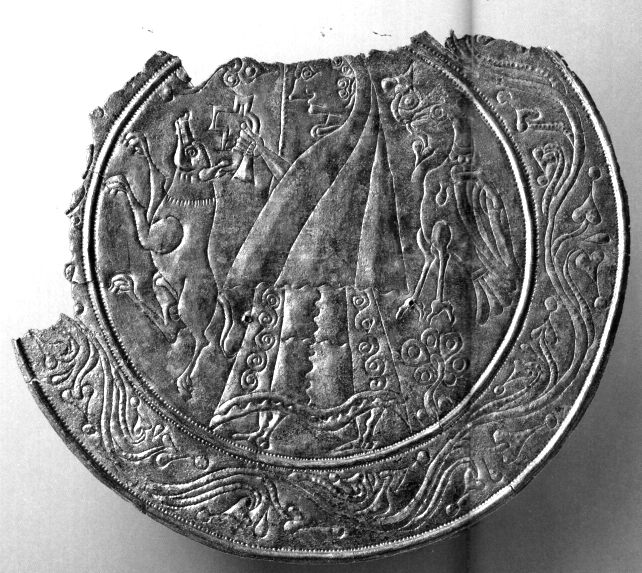
One of the most interesting archeological objects
from the ancient Veneti is that of a woman in a local costume. She also
reveals a particular hairstyle characteristic of Venetic women. Some
believe she depicts the Venetic goddess.
Votive
disc of Montebelluna, IV century BC. (Museo Civico di Treviso)
This
disc, it is believed, represents the Goddess, dressed in the Venetic
fashion of the day. The identity and relevance ot the animals on both
sides is worth further study.
There is much evidence that the Veneti,
even though they produced their own food and carried on metallurgy and
craftmanship, were mainly involved in trading activity. Goods were
constantly crossing the Alps on one side, and being shipped out into
the Mediterranean markets on the other. On the one hand there was amber
coming down from the Jutland Peninsula or southeast Baltic, and on the
other, traders ventured as far as the Caucusus in Asia Minor. Indeed
ancient Greeks identify the “Eneti”
name in Asia Minor. The "Veneti"
name moreover appeared by Roman times in northeast Europe in Brittany,
and in the form "Venedi"
on the Vistula and along the southeast Baltic coast. While traditional
thinking has seen them a farmers who migrated a lot, that idea is
not logical. Linguistically speaking, settled peoples diverge quickly
linguistically from lack of contact. It is impossible that they
would retain the same name in such diverse parts of Europe and over a
1000-2000 year time frame. Much more likely, the Veneti were a northern
equivalent to the Phoenician and Greek long distance traders of the
Mediterranean. The Veneti not only carried amber from the north to
Babylon, Greece and Rome, but also connected with brother colonies
across the northern seas. Once we begin seeing them as professional
long distance traders in the northern seas and up and down the major
rivers, we can apply truths about better known long distance trading
peoples such as the Phoenicians. Mainly long distance peoples
established markets along their routes and at terminals. That means if
archeology and ancient texts speak of amber coming down from the
Jutland Peninsula or southeast Baltic to the Adriatic Veneti, it is
valid to propose that the original Adriatic Veneti cities were
established from northern amber trader initiatives, and managed in the
northern language. When successful, these cities at the southern
terminus, drew surrounding peoples into it.
Although ancient trade was mostly by water – seas
and rivers were free highways never needing maintenance – because
of the barrier of the Alps, the Adriatic Veneti displayed plenty of
attention to the horse - a necessary animal for crossing the mountains.
Even if they could follow river valleys, while the rivers tumbled down
from the mountains they were often too rough for boats until they
reached the coastal plain. Because the use of the horse for
crossing mountain trails, as well as other uses, Venetic archeology
shows much reverence to the horse. Men involved in shipping might
become as attached to their horses or boatst. Accordingly a man's
journey into the afterlife might include either his horse or boat,
whichever applied to his profession
THE
ANCIENT VENETI LANGUAGE AND WRITING
A significant development among the Veneti was
the development of writing. Obviously influenced by the writing done by
the Etruscans to their south, the Veneti borrowed the Etruscan alphabet
and modified it to suit their language. Notably they added a couple
more letters and introduced a practice of placing dots before and after
some letters. Etruscans used dots, as did the later Romans, to mark the
boundaries of words. But the Veneti put dots throughout a word, and
that meant they used dots for another purpose. Scholars have speculated
on these dots. In my analysis of the inscriptions documented in THE
VENETIC LANGUAGE: An Ancient Language
from a New Perspective: FINAL
found that they were markers for a phonetic writing that specified
linguistic features like palatalization with the dots. These dots
were used like a linguist today, transcribing speech phonetically,
might add marks to indicate length, breaks, and other features like
palatalization, except the Veneti dots were not too specific They were
all purpose markers, I found, that generally marked deviations from the
pure sound caused mostly by interference by the tongue. I discuss it in
great detail in THE
VENETIC LANGUAGE: An Ancient Language
from a New Perspective: FINAL with examples.
But why use writing that described the sentences
phonetically? If the Veneti originated as long distance traders, I
think the phonetic writing approach developed from a need by traders of
being able to reproduce common phrases of foreigners encountered at
markets, even if one did not know the langauge –sentences like ‘this is
a good price.’ The word-boundary writing approach used by
Etruscans and later Romans, which is so familiar to us today (like
right here) requires prior knowledge of the language patterns.. Venetic
traders, thus, could create phrasebooks for all kinds of customer
languages, like Phoenicians did, and introduce dots to help in properly
reproducing it even if not understanding how the phrase was
constructed. If this is true, then there may be some instances of
Venetic writing containing another language, but we assume that most of
the Venetic inscriptions found in Northern Italy, reproduce the ancient
Venetic language dialect of the people there.
The Venetic language found in the inscriptions was
originally thought to have been a version of Etruscan. Then because
Greek historian Herotodus had mentioned “Ilyrian Eneti” (Ilyria was the
ancient region east of the Adriatic and north of Greece), the next
belief was that the Veneic language had been Ilyrian. Failing with that
theory, in the 1960's it was thought to have been an ancient Latin.
These hypotheses were all arbitrary guesses to be tested. Unlike the
Ilyrian theory that was limited by the lack of information about
Illyrian, plenty was known about Latin, and that promoted large numbers
of investigations, all seeking to decipher the inscriptions. Since
Latin was known, scholars loved to try to "hear" Latin-like sentences
in the Venetic inscriptions. The fact that some Venetic words
seemed close to Latin helped to solidify the belief Venetic was an
early Latin. The fact that it was only an arbitrary hypothesis where
failure was a legitimate option, was forgotten. Today tens of thousands
of academics fully believe that the Latin hypothesis is correct for no
other reason than it has been analyzed so much – as if the more words
are printed by scholars, the more correct
Since then there have been attempts to see if
Venetic was Celtic or Slavic. Some Slovenian scholars, inspired by
nationalistic pride, proceeded to try to find the Venetic inscriptions
were Slovenian-like. But none of the results of past deciphering of the
Venetic – whether via Latin, or Slavic, or anything else –
has been convincing. There is too much turning mystery segments into
meaningless proper names (ignoring the fact that ancient names were not
meaningless) There is also too much twisting words to fit each
other, or too much rewording poetically until some kind of non-absurd
meaning is reached. As far as grammar is concerned, either there is no
rationalization of grammar at all, or the grammar is assumed a priori
from the language used as a tool of interpretation, and not determined
from Venetic examples. And let us not forget the common practice of
scholarly papers showing only the handful of good results and hiding
the failures. (In THE
VENETIC LANGUAGE: An Ancient Language
from a New Perspective: FINAL
I hide nothing. I list all the Venetic sentences used in the study and
at the end acknowledge them all, even if some results are incomplete or
with some degree of uncertainty.)
Furthermore, all the attempts to decipher the
Venetic inscriptions have not done any proper deciphering, but rather
proceeded by trying to hear a particular known language in the Venetic
sentences – a methodology I call the ‘hearing things’ approach.
This is a methodology that can begin with ANY known language, and hear
that language in the Venetic – an easy process if the portions that
remain mysterious are arbitrarily assumed to be proper names.(ignoring
the fact that in ancient times names too had descriptive meanings.) The
methodology can be easily described in two steps: a)decide the Venetic
inscriptions are related to known language X, b) try to hear words of
language X in the inscriptions when sounded out, c) turn all the
portions that do not sound like words in language X into meaningless
proper names. d) play around with the results to make it seem
meaningful and not absurd. This is a methodology that will be
able to produce the same kind of inadequate results no matter what
language X may be.
I give one example of a past deciphering from
the Latin perspective.
.e..i.k.go.l.tano.s.dotolo.u.dera.i.kane.i
Venetic, divided by analyst : eik goltanos doto louderai kanei
Latin (literal): hic Goltanus dedit Liberae Cani
English translation: Goltanus sacrificed this for the virgin
Kanis
Note that the literal Latin barely
resembles the original and requires the invention of two proper names Goltanus and Cani.
It is nothing more than a puzzle game that
gives a row of letters and instructs the player to ‘construct a
sentence in your language from this row of letters’. This is what I
call the ‘hearing your language in it’ methodology that is really
essentially the same as hearing sentences spoken by wind in trees. In
this case the game was one of finding Latin-like words in the Venetic,
and then turning the rest into proper names and then manipulating it
all to form a coherent concept.
It did not help the situation when some words seemed
close to Latin (such as dona.s.to
sounding like Latin donato
and or .e.go seeming like
Latin ego).
The more Venetic was pursued as an archaic Latin-like language, the
more academia became convinced it was true. More recently the same has
been true of Slovenian pursuit of Venetic as a Slavic language. Here
too it seems the more noise is made about it, the more the laypeople
and naïve academics begin to believe it is true.
This approach resulted in presumptions about some
word stems and case endings, which in turn invited linguists to apply
their wisdom to the presumptions. Looking at what the past Latin
approach produced regarding grammatical endings, I found little more
than a presumption about gender marking endings, and a dative. They
were the only grammatical features with enough evidence in the Venetic
to seem to confirm them. The rest of the proposed case endings were
based on only one or two presumed examples. As for the presumed word
stems, because of the liberal way in which mysterious segments were
turned into proper names, a third to a half of the word stems listed
were such meaningless names of deities and people. But is it valid to
simply assume untranslatable leftover pieces were proper names? Any
mother looking for a name for her baby and studying books of names,
knows that all popular names had meanings in their original
languages. Linguists, assuming the work was collected, leapt onto
the bandwagon with their own interpretations of linguistic shifts, etc.
But the reality is that this methodology would allow Venetic to be
‘proven’ any language on earth. For example a Chinese analyst could
also look for Chinese-sounding elements, and then turn the left-over
pieces into presumed proper names. And then the linguists would leap
forward to make linguistic pronouncements, with reference to Chinese.
(Anyone who disputes this, is welcome to test it themselves. Give some
Venetic sentences to a Chinese analyst and tell them it is an ancient
Chinese written in Etruscan letters, and prove it for yourself.)
The Ancient Veneti, by my theory, managed a long
distance trade network, of which the Adriatic, Brittany and Vistula
Venedi were three major nodes in the system. As long as the long
distance shippers/traders were in contact with one another, the
language remained relatively unchanged throughout the system. With the
rise of the Roman Empire, Romans established control over all economic
activities, and that included Romanizing the original trade systems.
The original trade systems were compromised. The major Venetic regions
– Brittany, southeast Baltic, and north Adriatic – were cut off from
one another, so that the regions became more localized. The north
Italic Veneti assimilated early into Latin when the Roman province of
Venetia was created. Later the Brittany Veneti assimilated into Celtic.
Finally the Venedi of the trade routes connecting the Baltic to both
Black Sea and Adriatic Sea assimilated into the Slavic peoples who were
their major customers. Before the original Veneti were completely
melted into their surroundings, there was a 1000 year period during
which historical texts could imply the Veneti in the three regions were
Latin, Celtic, or Slavic. There is some validity therefore in speaking
of Latin Veneti, Celtic Veneti, and Slavic Veneti for the 1000 years of
the post-Roman era, before the name itself disintegrated. But it is
incorrect to project post-Roman information to before the Roman Empire
as if the Roman Empire was an insignificant historical event, instead
of a complete transformation of Europe.
In the post Roman period, obviously the north Italic
Veneti became Romanized and today’s Veneto dialect arose from Veneti
assimilating into Latin. At the same time, obviously the Venetic
traders travelling from the Baltic, via the Oder or Vistula to the
Black or Adriatic Seas were now selling their wares to Slavs expanding
in every direction around the east side of the Black Sea and they
assimilated into Slavic. (It is interesting to note that the Roman
historian Tacitus, in Chapter 46 of his Germania, wrote that the
Vistula Venedi, by 98AD, were acquiring “Sarmatian” wives and
customs, and losing their original characterisitcs of the geographic
region of Germania. Since the Roman view of “Sarmatia” covered the
Slavic territories, he was in effect saying that the Venedi were
becoming Slavicized in his time (98 AD) It means the Venedi was
NOT Slavic before the Roman era.
In this article we distinguish the original ancient
Veneti from the post-Roman Latin, Slavic, Celtic etc Veneti, through
the term ‘Ancient Veneti”
As a result there is a war between the groups. Each group claims that
the Veneti were Latin, Slavic, Celtic, or some other alternative back
to the beginning of time (so to speak). Speaking in terms of another
long distance trading people – the Phoenicians – that would be like
discovering that the Phoenicians of Spain spoke Latin after the Roman
Empire, and then claiming they were Latin back to the beginning of
time. In that case, the Phoenician language is known from elsewhere in
the ancient world as a Semitic language.
In this war of Venetologists the arguments are based
distortions, trickery, reference to selected supportive ideas in
historical texts, geography, archeological discoveries, etc. But this
achieves no resolution. The truth about the pre-Roman ancient Venetic
language lies in a PROPER deciphering of Venetic inscriptions like
documented in THE
VENETIC LANGUAGE: An Ancient Language
from a New Perspective: FINAL
2.
THE
VENETIC WRITING - THE OBJECTS
THE
ORIGINAL ANCIENT
LANGUAGE RECORDED IN THE VENETIC INSCRIPTIONS
We would today have no idea what the ancient Venetic language was like
if archeologists had not found inscriptions. What is the nature
of the objects archeology has been finding that serve as carriers of
the ancient writing and the language it reflects?
The first major archeological discovery in northern
Italy was made in 1876 at Este when two burial tombs were discovered
containing numerous cremations and bronze artifacts. In the next six
years, hundreds of such burial vaults were discovered and investigated.
These and subsequent investigations led to the rich world of
archeological finds of the Este area. Many of the archeological objects
had writing on them in an alphabet that resembled the Etruscan
alphabet. It was evident that before the rise of the Romans, the
Eneti/Veneti cities at the north end of the Adriatic Sea, borrowed
writing habits and alphabet from the Etruscans to their south and
adapted it to their own language. With it, they put their language onto
objects of ceramic, stone, and bronze (and no doubt many other
materials that have since decomposed) primarily during the period
between 500BC and 100BC when the Venetic cities were at their peak, and
ancient Greek historians described them as a wealthy civilization of
"50 cities" who were also the agents for northern amber being
distributed into Mediterranean markets.The objects on which they wrote
their inscriptions were objects with special uses in their religious
and regular lives. All sentences are short, and an addition to the
object and its purpose.
The Veneti made plenty of ceramic containers. The
techniques of making ceramics were varied and sophisticated. Much
pottery was decorated before or after firing. Some containers of
terracotta were used to conserve cereal grains and legumes, to cook
food, and of course table ceramics for eating and drinking. The form of
ceramics that was inscribed by writing was the cremation urn.
Example cremation urn inscribed with
writing
The cremation urns have provided the largest
quantity of examples or writing. They can be viewed as sendoff messages
to the cremated deceased inside. The (V)Eneti followed the
practice as spread in the “Urnfield Culture” (which can be associated
with (V)Eneti colonies elsewhere in the trade system of Europe), of
cremating their dead, placing their cremations in urns, and placing the
urns in tombs or in burial vaults. Along with the urns the tombs
contained valuables, perhaps that belonged to the deceased. In some,
goblets, plates, etc. were interred, perhaps from the funeral
banquet(?).
Outside the tombs, one might find stone obelisques
marking the locations of the tombs. The stone that stood upright, one
end rooted in the ground that typically had written on it a sentence
beginning in “.e.go….”
These texts have been interpreted traditionally, using the Latin
ego, which means ‘I’. It is not very believable that the deceased
said "I am -----", when throughout history tomb markers have been
dominated by the sentiment - rest in peace, or in memory. (I offer an
alternative below, that claims .e.go meant
'let remain, rest')
An example obelisque with its
inscription, that marked tomb locations
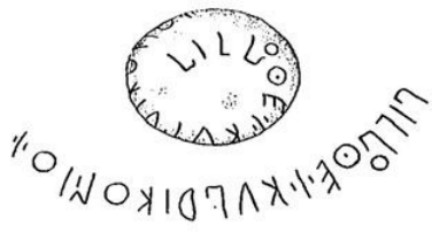
Also connected with tombs but perhaps it was a custom unique to the
Pernumia area south of Padua, were a small number of round river stones
engraved with texts. They were left at the bottom of tombs and the
context of it suggests they were additional personal messages added
before the tomb was closed up.
Example round inscribed strone left at
bottoms of tombs at Pernumia
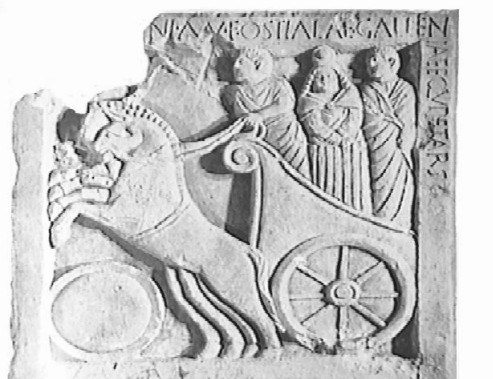
Getting away from funerary inscriptions (which are sad) we can look
now at sentences surrounding relief images on pedestals. These, we
found, look and sound like memorials, and perhaps some of the memorials
related to deceased, but many celebrated other notable events
–marriages, armies going off to war, distinguished visitors depart.
Example memorial stone, this is a later
one with Latin text which I believe announces a married couple setting
off on a honeymoon.
Another category of objects are objects left at sanctuaries,
religious places, where offerings were made to the Goddess. According
to ancient Latin and Greek authors, the sanctuaries in the north
Adriatic landscape included groves in a natural state often fenced in
to define their boundaries. Inside the sanctuaries space one would find
the facilities – including pillars, statues, pedestals, etc – for
practicing the religion whether it be processions, rituals, prayers,
burnt offerings. Permanent temple structures were only built in more
important sanctuaries in the larger cities. Religious rituals carried
out at the sanctuaries included purification rituals involving liquids,
and sacrifices of animals to deities. There were sanctuaries associated
with important urban places – marketplaces, ports, etc. There were
public sanctuaries associated with political and military centers
in a region. Communities too might establish sanctuaries in
association with natural features like springs. Ceremonies and rituals
were carried out at sanctuaries. It was something like an outdoor
church..
At the Baratella sanctuary near Este archeologists found large
numbers of bronze styluses. Most of these three sided writing
instruments had no writing on them, but some did. Why the accumulation
of them? Why did people leave them with their offerings - with or
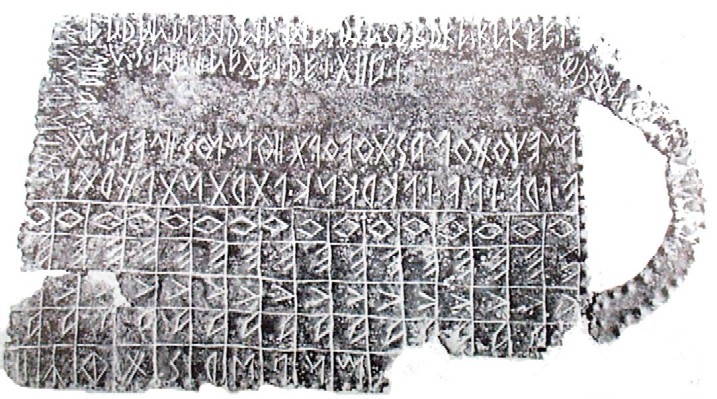
without inscriptions? The answer is they must have used the stylus to
write a prayer at a shrine, on a thin soft sheet of bronze – a
few examples of which have been found. Once the prayer had been
written, the stylus was left behind, in a place of collection, perhaps
eventually to be recycled. Since it was only used at the sanctuary,
there was not reason for anyone to take it home.
Example inscribed styluses used to inscribe messafes on thin bronze
sheets (below)
An example bronze sheet on which a message to the Goddess was
inscribed
The above categories - the urn, obelisque,
round stone, stylus and sheet - represent those categories for which we
have several examples of each - which allows us to employ comparative
analysis to affirm some repeated words and elements. There are
also some other groupings possible but the most interesting are the
inscriptions on miscellaneous objects – isolated finds, often of a very
common secular nature, which represents the everyday writing that
has been lost because it is not on durable objects nor accumulated in
large quantities anywhere. These randomly discovered objects
demonstrate the Veneti people used writing in very ordinary ways
as well. We can only imagine how extensively ordinary people may have
used writing on objects that did not last in the ground!
It is because ordinary writing does not accumulate
and was done on materials that decomposed, the body of discovered
(V)Eneti inscriptions as a whole are dominated by sentences found
on sanctuary and cemetery sentences. Accordingly past interpretations
have looked for solutions based on Roman patterns in later
cemetary or sanctuary inscriptions. This has led to the scholars
allowing most of the inscriptions to resemble what we might see today
on gravestones and memorials –a few keywords and names assumed
from untranslatable fragments. This allowed troublesome portions of
text to be viewed as proper names, and for the translations to be
non-sentences with assumed ideas.
Unfortunately, the number of examples of Venetic
writing is relatively small. Several hundred examples have been
found, but most are fragmentary, There are less than 100 good,
complete, inscriptions. When the number of full sentences is small, the
repetition of word stems, case endings, and patterns in style and
meaning is also small. It reduces the ability to confirm
suggestions about meanings or grammatical elements through internal
comparisons (between sentences containing the same word stems and
grammatical features).
The greatest shortcoming of the body of Venetic
inscriptions so far uncovered is that there are no examples of
inscriptions with an accompanying translation in a known ancient
language. Translations could at least establish with certainty the
words and grammar of that particular writing and then carry these
discoveries into other inscriptions. The successful translations of
ancient unknown texts have always had examples of writing with parallel
texts in a known ancient language. For example headway has been made
into Etruscan because of inscriptions with translations in a known
language like Phoenician.
Past successful deciphering of ancient writing has
benefited from at least a few translations in a known ancient
language like Greek. Having a few translations allows the analyst to
acquire a few solid, certain, words. Let us say that we determine
the meanings of two words of the unknown language to mean ‘man’ and
‘food’. We can then look for those two words in untranslated
examples of the unknown language. For example we find ‘man’
---?--- ‘food’ and we can infer that the ---?--- word could be ‘eats’.
We can now TENTATIVELY assume ---?--- means ‘eats’ and look for that
word elsewhere. Then when we manage to get partial translation in
that other location, we can see if the interpretation ‘eats’ fits. Back
and forth we test good possibilities for the unknowns between the
knowns we acquired from the parallel translation. This is exactly how a
baby learns language. One day the mother points to a dog and tells her
baby it is a ‘doggy’. The baby assumed that is the word for
a four legged creature. But then on another day the baby points to a
cat and says “doggy”. The mother replies “No, that is a kitty”.
Language learning is all about making hypotheses and testing them until
one arrives at a system that works – the final meaning of the word is
the one that works correctly everywhere it is used.
This example suggests that there is another way of
determining meaning – from context. When the baby points to a dog
or a cat when saying “doggy” or “kitty”, she is captioning a real
object. In the case of ancient inscriptions, it helps if there are
pictures associated with the text. The writing has to be captioning the
pictures. Furthermore there are labels. If we buy a refrigerated carton
in a foreign country that shows the image of a glass of milk, we can
assume that the word for ‘milk’ will be prominent in the writing on
that carton.
3.
THE
MYSTERY AND THEORIES ABOUT THE ANCIENT VENETIC LANGUAGE
THE
ARBITRARINESS OF PAST IDEAS ABOUT VENETIC
Without archeology ever finding translations
of Venetic in a known ancient language, the investigation of the
meanings in the Venetic inscriptions has been quite blind. They have
had to advance theories based on periferal or indirect evidence.
Ancient history only tells us (Polybius) that
although allied with Romans in wars against Celts, and employing
customs in Gaul, they spoke "their own language". This at least
should tell us Venetic was not close enough to Latin or Celtic or any
other well known language of the time to be seen as a dialect of it.
The first scholarly proposal some centuries ago was
that it was a northern Etruscan. It was suggested purely from their use
of the Etruscan alphabet. The next proposal that it was an "Illyrian"
language (Illyria was the ancient region east of the Adriatic and north
of Greece) was based on the ancient Greek historian Herodotus
mentioning an Ilyrian "Eneti". These early proposals failed to be
fruitful and in the end someone said why can't we assume it was
ancestral to Latin? It was a guess, based only on the fact that Venetic
was located in the Italic Peninsula like Latin, and because the
Venetic inscriptions provided a few words that looked remarkably like
Latin - for example dona.s.to
and .e.go closely resembled
Latin donato and ego.
This final theory in the academic world produced a great amount of
scholarly analysis for the simple reason that Latin is well known and
anyone who knew Latin could try to see if they could hear Latin
sentences within Venetic inscriptions. The results however are
very poor by scientific standards - often being little better than
hearing sentences in the sounds of the wind through the trees. Then
scholars, finding the results a real mess, tried to bring some
linguistic integrity into the accumulated Latin-oriented study, now
only assuming only that Venetic was an ancient Indo-European that need
not be ancestral to Latin but maybe related. That is how the pursuit
stands. But the results were still not convincing. The fact that by the
1980’s some Slovenian academics took on the Venetic inscriptions
with Slovenian and Slavic proves previous work was not convincing
enough to discourage new theories. But the Slovenian approach too
simply tried to hear Slovenian-like sentences in the inscriptions.
There has been no rationalization of word stems or grammatical elements
– just a lot of trying to ‘hear’ Slovenian-like sentences in the
Venetic when sounded out, followed by plenty of massaging and poetic
twisting to arrive at meanings that do not sound absurd.
In the absense of any way to determine the meaning
of any words through a parallel translation in a known language, the
entire history of analysis of the Venetic inscriptions has been like
blind scholars wandering this way and that with arm’s stretched out,
and making guesses about what they are feeling and where they are going.
If you have committed to one hypothesis, will you
admit defeat and stop? No. Who can admit they have spent years of their
lives achieving nothing? Let us not forget that the proposals that
Venetic was Latin-like, Slavic-like, etc have only been UNPROVEN
HYPOTHESES, and that all they are doing is testing the unproven
hypothesis. Then, over time the academic world forgets that the
linguistic nature of Venetic had simply been arbitrarily advanced for
testing, and after thousands of man-hours have been spent, everyone has
completely forgotten that the notion that Venetic was Indo-European in
a Latin-like way or in a Slavic way, as the case may be, has always
been an arbitrary hypothesis advance for testing, and that if
the testing has not produced convincing results, the option that the
hypothesis was incorrect is a valid conclusion and that it is not
necessary to keep forcing the hypothesis onto the Venetic.
This is different from having a priori
proof before attempting the deciphering. For example, if the Venetic
inscriptions were FIRST proven to be an archaic cousin to Latin, then
the pursuit with Latin would be valid. For example if Polybius had said
"Eneti spoke their own dialect of Latin" then that would form a
non-arbitrary foundation for the pursuit.
But if the Latin hypothesis were forced onto Venetic
for no reason to test yet another hypothesis, then everything that
follows is a testing of the hypothesis and one of the valid results is
that the hypothesis is false. But this is forgotten, and the analysts
now have assumed it to be true and will not admit that they may have in
reality disproven the hypothesis from general failure.
If modern scholars do not realize they are ONLY
exploring a hypothesis they will tend to regard poor results as their
own failures in analysis, and not as a failure of the initial
hypothesis.. But there has always been the option that the hypothesis
was wrong and the failures in achieving the believable and convincing
results are the consequence of all the hypotheses being incorrect.
The entire methodology followed in the past half
century has been wrong. Instead of guessing the linguistic nature
arbitrarily and then spending years of frustration on an erroneous
path, why not pursue the determination of the correct hypothesis first,
before investing a great time and effort testing with a known language?
Too little academic energy has been spent trying to find evidence that
eliminates the guesswork. Instead of a history of blind men walking
around in the dark and making guesses, Is it possible to prove a
hypothesis of linguistic affiliation a priori before beginning to try
to force Latin (or Slavic) into the inscriptions based on vague
similarities in sound? Certainly it would be possible if we had a
parallel translation. But is that the only way?
A
FURTHER OPTION OF VENETI ORIGINS: TOWARDS THE NORTH
The problem with making an a priori hypothesis and
then getting stuck with it because nobody wishes to admit failure, is
that the hypothesis becomes entrenched and nobody then considers any
alternatives. All the alternative options, such as Venetic having
come from the north via amber traders, are shut down, and the entire
quest for discovering Venetic truths comes to a dead end. Let us
consider other options that the narrow stance of the past has thwarted.
For example, there has always been a valid
possibility that Venetic was NON-Indo-European, especially since Venetic had two acknowledged
NON-Indo-European languages as neighbours
- Etruscan and Ligurian. Indeed Etruscans were close neighbours and the
Veneti adopted the Etruscan alphabet. Why has it not been pursued? The
explanation is too simple: everyone knows Latin, but nobody knows
NON-Indo-European languages. It was an academic path of least
resistance!
Furthermore, the pursuit fell into the rut of being
focussed mostly on the sentences themselves, and little serious
analysis has been given to the archeological objects and contexts in
which the sentences have been found. But the more information you can
look at the better. As any crime scene investigator will attest, the
more information you collect, the clearer the truth becomes. Consider
what analysis of the archeological side of things can reveal.
Archeology can tell us if the object was connected to a funerary
ritual, acted as a memorial, marked a tomb, etc. Then we have a sense a priori
what messages would be most probable for that object and context. It
gives us a basis for accepting some possibilities and rejecting others.
Then there is archeological discoveries about the
world in general. For example if we see that the Veneti were intimately
involved in the Greek dominated Mediterranean, then the probability is
very high that the Veneti would worship the well established deity
Rhea, and not invent their own called “Reitia”. What else can we
infer from archeology on the larger scale? In the past century of
archeology, it has been discovered that amber came down to the north
Italic region from two sources in the Baltic, the Jutland
Peninsula and the southeast Baltic coast. Therefore we can
entertain the possibility that a northern language was transferred
south through this path of contact. In other words we cannot restrict
our attention to the Mediterranean. According to archeological
discoveries, the north Italic region where most of the Venetic writing
has been found was at the bottom of the amber trade route from the
Jutland Peninsula. From these origins, archeology has discovered from
amber dropped along the route, that amber goods travelled up the Elbe
River, crossed the Danube Valley to the Innsbruck area and then
descended the Adige River valley to the Venetic colonies at the bottom
of the Adige. This opens the possibility that the Venetic
language in the inscriptions came from the Jutland Peninsula,
established as a new southern terminus for amber trade.
Scholars have not excluded this possibility as they
have wondered if Venetic was Germanic, and while they found some
features that seemed Germanic, the conclusion was that it was not
Germanic. The Germanic hypothesis has not been pursued. That means
since the Venetic inscriptions were made before the Roman era, we
should be dealing with the unknown language that was found in the
Jutland Peninsula before the Germanic (Goth) militaristic expansions
northward from central Germany. And to identify that unknown
language, we cannot simply look at historical languages, but recognize
the aboriginal foundations of northern Europe, which were Finnic (like
the Saami, Finns, Karelians, Estonians, Livonians, and many other
remnants across northern Europe as far as the Urals.)
Archeology has found that the aboriginal peoples of
northern Europe began as reindeer hunters, but then became general
hunters of a flooded wilderness as the reindeer tundra
disappeared. The new culture, called the “Maglemose" culture,
spread across the north as far east as the Ural mountains with dugout
boats, and then invented skin boats (skin-on-frame construction) in the
arctic where there were no trees for dugouts. While linguists can
argue over fine points, looking at the broad picture, the aboriginal
peoples of northern Europe were boat peoples, and as such could easily
adapt to farmer civilization by performing the role of long distance
traders. With such boat-oriented roots, descendants of the aboriginal,
indigenous, north Europeans, were preadapted to enter into roles in
long distance shipping/trading, and for that reason we have to find
that the most likely large scale trade language across the northern
seas remained Finnic. in character even as intermarriage with the
farming peoples altered the original peoples in the caucasian direction.
It is well known that in the Mediterranean, the
Phoenicians established trading colonies everywhere they went, and set
up trade networks. Greek traders did the same. This was a standard
practice of long-distance traders.
What if, derived from the northern trader tribes, amber
traders of the Jutland Peninsula established the trade route to the
Adriatic, and that formed an ongoing relationship via trade, or they
may even have established the colonies at the south end of the route
and planted colonies of their own people there. That was what we know
other long distance trader peoples did. Ancient Greece was
a major customer for amber, dating to over 2000 BC. The original
colonies at the lower Adige River could have initially been established
as trade centers for handling goods coming from the north, and goods
heading onward into the Mediterranean markets. Once established and
successful the Venetic cities would have drawn surrounding peoples into
their midst, but preserved the northern language as the general
language of the region.
Such an investigation of archeological knowledge on
a larger scale raises the possibility the Venetic inscriptions
CAN have a high probability of being Finnic in character. The
wider our net for information gathering, the more we open our mind to
possibilities not thought of previously. If indeed the Veneti were long
distance traders, we cannot look at the Venetic inscriptions purely as
a local phenomenon.
We cannot isolate the Venetic inscriptions from the
ENTIRE context in which they occur – not just the local context of a
funerary site, etc, but the larger context suggested by the name
appearing through ancient history in Babylon, the coasts of the Black
Sea, Illyria, southeast Baltic, Vistula, Oder, northwest Europe,
Adriatic Sea, etc….Once we decide they were long distance traders based
in the north and dominating major rivers, we begin to view the Venetic
inscriptions in a new way.
Our first step is to ignore that actual Venetic
sentences, and study the entire archeological context for what is
possible and then evaluate all the possibilities for what is
PROBABLE. Then we will have a good intuitive sense of what the
sentences will say, and at least we will have a sense of what is
absurd, what is possible and what is both possible and most probable.
By always selecting what is most probable, we gravitate towards the
truth. We can then determine when we are proceeding towards the truth,
by finding our discovery of the language accelerating like always
happens in correct language learning.
It is only then that we begin to note that the
resulting language that we discover has similarities to one known
language or another. If we then employ that knowledge as an additional
tool, we are no longer forcing something onto Venetic, but employing a
correct tool for further revealing the truth.
4.
SEARCHING
FOR THE PROPER
METHODOLOGIES OF DECIPHERING ANCIENT INSCRIPTIONS
THE
PROPER WAY TO
DECIPHER THE VENETIC INSCRIPTIONS
The practice employed with the Venetic inscriptions of simply making a
hypothesis of affiliation with a known language and then trying to hear
that known language in the inscriptions mentioned above, has not the
normal approach in deciphering ancient inscriptions.
Past successful deciphering of inscriptions has been
approached from an archeological direction, where every piece of
information connected with the writing is brought into the deductive
process. Unlike a linguist, who views sentences in isolation, an
archeologist sees the inscription wholistically in the archeological
context, and then the writing is treaded like elements of the
archeological whole, and the task becomes an extension of interpreting
the archeological information.
Linguistics looks only at the sentences, and a great
amount of information that can reveal meaning in the inscriptions is
lost. For that reason an unknown language cannot be deciphered by
linguistics. Meaning is found in the context in which a language is
used and that means we must observe the language in its real world
context. A linguist trying to understand an unknown language
being spoken by a newly discovered people, can only determine meanings
from observing it in use. A baby too needs context from which to infer
meaning. We cannot separate language, whether spoke or written, from
the real-world context in which it occurs. Iif we went to a foreign
country today and found a jar with a word on it, and there were beans
inside, we can determine that the word means 'beans', whereas when that
word is separated from this context, it cannot be deciphered.
Linguistics needs a correct understanding of the relationship of an
unknown language to a known one to proceed without any reference to the
realworld context. But if the relationship is unknown, then linguistics
is blind. Archeology is not, since archeology has the realworld context
to investigate.
But the amount that can be discovered from a
wholistic archeological perspective varies with the situation. As I
mentioned earlier, if there is an archeological find that shows a
translation in a known language beside the unknown language, then there
is less need for inferring meaning. It would be like a student of a
language looking up a word in a dictionary, rather than making and
testing guesses. Unfortunately archeologists have never found a Venetic
inscription that is accompanied by a parallel text in a known ancient
language, and it has never been possible to determine a few words with
certainty. Scholars may believe that translating words like dona.s.to and .e.go
with Latin donato and ego ; but these may be coincidences since human
languages use the same limited number of vocal sounds. All languages
will have words that are similar in sound to words in any another
language. We cannot go by a few similarities. The similar
sounding word in one language can mean something completely different
to a similar sounding word in another language. For example the first
of these, dona.s.to, resembles
Estonian toonustus 'something
brought' and the second, .e.go
, resembles jäägu
'let remain'. And then we can investigate other languages and
find similarities there too. Even English – which did not exist back
then – can give us donate and
ego
We can imagine the absurd sentence we would get from that. Thus mere
coincidence with a known language proves nothing. It is not
enough to find dona.s.to and .e.go is similar sounding
to Latin donato and ego. Proof is needed that these
similarities are valid, and not the similarities in another language.
If we lack any discovery of a parallel text in a
known language, we can still learn a great deal about the language by
the traditional direct methods described above that approach the
inscriptions from an archeological point of view. If we can find some
words in this way that can be viewed as certain, we can then have the
handful of solid words we can then use to leverage more words, just as
well as if we had found a parallel text.. Since the Venetic texts are
written on objects with a clear purpose and context, Venetic has always
been a very good candidate for looking for highly probable meanings in
this way. But until I tried it, I don’t think it had been tried before.
I have already described how a visitor to a foreign
country might learn some words of the unknown language from the way
they are used. For example the word in a sign above a bin of apples
probably says 'apples', or the large word on a carton of milk, probably
means 'milk'. A red stop sign at the end of a street probably has a
word that means 'stop'. By searching all the objects that have
inscriptions on them, we can find some
for which the objects and their use suggests highly probable meanings
of some words in the inscriptions. We only need to find a handful of
words whose meaning is obvious, which also appear elsewhere, to
leverage meanings in still-unknown words in other sentences. For
example, if we have one word that also appears on another object in a
two-word sentence, we can use the context of the other object and the
meaning of the one word to make a very good guess for the meaning
of the second word. The proposed meaning of the second word can then be
tested on yet other inscriptions. Soon we will find four word sentences
in which three words are known and we can infer the fourth. The process
accelerates. Every new discovery leads to even more discoveries, so
that if we observe the deciphering becoming increasingly easier, we
know we are on the right track. If we get stuck, then we can conclude
that we made a mistake earlier and we can backtrack and try another
alternative.
This is the traditional methodology of interpreting
ancient unknown inscriptions directly. A handful of correctly
deciphered words can be leveraged to decipher a hundred words, . This
methodology, when it produces correct results, accelerates, just like
when a child learns its parents' language, its learning accelerates -
from a very slow start, the child is speaking well by the age of
three. The same should occur in deciphering ancient writing - as
long as the analysis is correct, the analysis accelerates. It is a way
to sense it is on the right pa th. If the analysis gets stuck,
the analyst has to backtrack and look for the error
This acceleration is counter-intuitive since in
ordinary learning, the more one learns the more challenging further
learning becomes. But language is not a body of knowledge, but a
system. In any learning about using a system., the more you know, the
faster you learn more. For example learning to play a musical
instrument is learning the system of making music. The beginnings are
slow, but then the learning accelerates. The fact that analysts have
fussed over Venetic for centuries should be proof that the analysts
have been on the wrong track. Any belief that deciphering Venetic
should be a struggle of many centuries is completely false. A correct
deciphering can begin very slowly but like a child learning its first
language, to be on the correct path it should accelerate - that is take
several months and not several decades or even centuries.
The methodology presented below resulted in the
deciphering of most of the known inscriptions within two years
(2002-2004) with the discoveries constantly accelerating. This
parallels how a child learns its first language. We learn
Venetic by starting with the simplest sentences.
EXAMPLE
OF
IDENTIFYING A VENETIC WORD FROM INTERPRETING THE CONTEXT
When dealing with the written language children's books are filled with
illustrations that describe what the words are saying. Comic
strips and cartoons too provide visual information to help interpret
the texts.
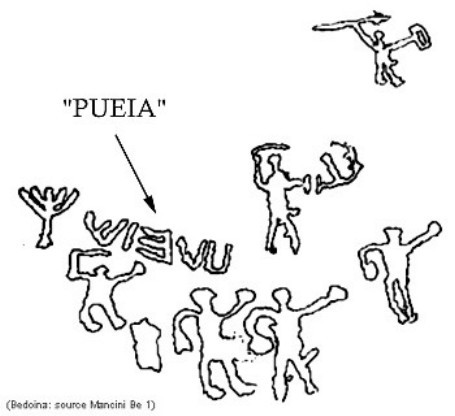
There is one Venetic inscription that is like a
cartoon. The figure below represents an isolated find on a rock face in
a mountainous area (Bedoina) in north central Italy. The image shows
five men with fists raised shouting “pueia” while a man in the distance
seems to be running away. The treelike symbol with the five branches in
my opinion says five foreground men shouted it in unison. It is
analogous to a balloon in a comic strip.
Carved onto a rock in the mountains,
this illustration tells a whole story and limits the the possibilities
for the word that they are all shouting. It is like a cartoon with a
word balloon.
ANALYSIS:
It is important to note that the foreground men have their fists
raised. This suggests anger. But three of them have no weapons.
Therefore they are not a group of warriors heading after someone
and saying possibly “charge!” or something. We study the picture. Use
some shrewd analysis. It seems the fleeing man has upset the three
closed-fisted men. But the remaining to foreground men do have swords
and seem to be after the fleeing men. It seems to me that they are
shouting “After him!” or “Catch him!”. If these the foreground men had
no swords, and only fists, then we can propose they were just shoutiing
“Get out of here!” or “Go away!”. Thus the image as it is, seems like a
community set some armed men, maybe policemen of a town, to chase after
an escaping enemy or criminal. It would be consistent with chasing him
into the mountains. Reaching the mountains, maybe the fleeing man
escaping, they camp for the night and create this picture to record the
event.
Thus after analyzing the possibilities, the
most probable choice is that pueia
means ‘catch him!’m ‘stop him!’ or similar.
Tentatively assuming pueia means ‘Catch him!’, the next
step in the methodology, is to look for this word pueia in
another inscription and hope the context of the object and other words
support this same meaning. But this word does not occur elsewhere, and
in this case we are unable to use this word to leverage more words in
other sentences,
We can accept that pueia means ‘Catch him!’ and that would be a good
example of deriving a meaning without any reference at all to any known
language.
But should we ignore known languages? No. If we
allow the Venetic to search known languages for words that are similar
in sound and mean something similar to ‘Catch him!’ then we are not
forcing any known language onto Venetic, but allowing Venetic to scan
known languages for the best fitting word in any candidate language.
What is nice about this is that since Venetic does the searching, it
doesn’t matter too much that the languages scanned are modern ones,
since the Venetic will only see the remnants of actual ancient words in
that modern language.
Nearly all languages will have something sounding
similar to pueia,
but only one may have a meaning close to the desired meaning ‘Catch
him!’. The reader can scan known languages to find a word that fits the
meaning we arrived at from the picture. But ultimately the reader will
find the closest known word is in Estonian (a Finnic language) and its
word püija! 'catch (him, her, it )' Other languages may have
similar words with meanings that could be poetically manipulated to be
possible, but we are not interested in what is possible, but what is
MOST PROBABLE that ordinary humans would shout in the situation
depicted.
At least in this methodology we are not simply
matching sound, but also matching the meaning implied in the
information in the archeological context . This greatly reduces
the chance of false paths of analysis. In this way, it is the Venetic
that is projecting into its best known language, and not vice versa. In
general, as in a court of law, the more evidence there is pointing to
the same conclusion, the less the chance that our conclusion is just
opinion or wishful thinking.
As I said above, we could omit scanning known
languages completely and that would be ideal. However if eventually the
revelations from the direct approach keep pointing to Venetic being
Finnic in nature, then how can we not extend our methodology to use
Finnic language (Estonian or Finnish) as an addition tool to confirm
the meanings found directly, or even to suggest possibilities. The
truth is that had I not eventually begun using Estonian as an
additional tool, my results would have been more vague. The main
benefit when I began checking words with Estonian was to CONFIRM or
REFINE meanings. For example discovering Estonian püija!
'catch (him, her, it )' helped to settle on ‘Catch him!’ instead of
‘Stop him!’. It means they are trying to capture the fleeing man,
and not simply stop him.
EXAMPLE OF IDENTIFYING A VENETIC
WORD FROM INTERPRETING THE CONTEXT: GIVING A DUCK TO AN ELDER
The next example is a better one, as it produces discoveries that can
now be applied more widely since it contains words found often in other
inscriptions - it permits internal comparative analysis between all
sentences in which a word is repeated..
1. THE CONTEXT.
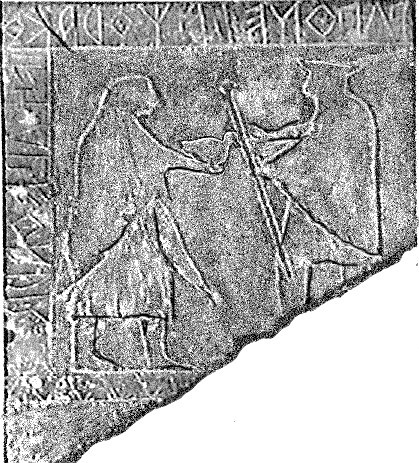
This example is one of the inscriptions on the pedestals with relief
images. I believe they were intended as memorials of events, and did
not necessarily refer to someone passing on. For example there is
one in which we see chariots and our interpretation suggests
commemoration of the departure of an army into the mountains the engage
in a war. The example we will decipher appears to commemorate an event
where an important religious or political elder pays a visit, and upon
leaving is given a duck for the journey. It is a lovely example to
interpret directly because it gives a unique illustration depicting
what appears to be a peasant, maybe a fisherman or hunter, handing a
duck - probably a real duck - to a distinguished-looking man with a
cane. And the sentence obviously captions what we see in the image!
This image tells a story that will
reflect what is stated in the surrounding text. What does the duck
represent? It is possible that water birds were sacred to the Veneti.
See the earlier image on the disc, which shows a bird, possibly a swan
on the other side. Or was the duck given as something to eat on the
journey.
1. THE
INSCRIPTION:
The Venetic inscription is written continuously, in the fashion of
Venetic inscriptions and when the text is converted from the Venetic
alphabet to Roman small case alphabet, and including the dots in the
Venetic text, it reads - when the Venetic alphabet is converted to
small case Roman alphabet but preserving the dots:
pupone.i.e.gorako.i.e.kupetaris
(Notes: Reading the
dots. The dots in the
conversions of the originall Venetic writing to small case Roman
alphabet represent palatalizations of the sounds on either side of a
letter, and other features like trilled r, or aspiration. It
mostly affects how the language sounded, and it doesn't greatly affect
our discussion. For example .e.go only means it sounded more like "YHE-EGO"
instead of a pure "E-EGO" For detailed discussion of the dot
puncctuations see THE
VENETIC LANGUAGE: An Ancient Language
from a New Perspective: FINAL)
3.
IDENTIFYING WORD BOUNDARIES:
For interpreting we need to break it apart into words. We can divide it
easily from identifying some of the words in other inscriptions. In
this case, the identifiable word .e.go
occurs in the middle, and .e.cupetari.s.
which is a word from how it is used in other sentences, at the end.
Thus the word boundaries for the remaining two unknown words are
obvious. The sentence with the word boundaries shown as spaces is:
pupone.i
.e.go rako.i. .e.kupetaris
4.
INTERPRETING THE CONTEXT:
Looking at the illustration we can propose that the text describes how
a peasant is giving a duck to a distinguished-looking gentleman as
suggested by his clothing and cane. We can expect that the words ought
to at least identify the central object, the duck. The first word
appears to have the stem pupo-.
We can determine this because the remainder -ne.i. appears as an ending in many
other sentences and is therefore a grammatical ending. pupo
sounds remarkably like universal words naming 'father'. It is the word
from which PAPA comes, and more importantly it is in the tradition of
the Italic Peninsula in being used to name the Pope. I believe
this was how in all the Italic Peninsula it was common to call a
leader, a city or county elder, as a ‘Father’ even before Christian and
Roman times. In conclusion we can propose that pupone.i.
may mean 'to the distinguished father' and that suggests that the word
for 'duck' will also appear in the sentence. Further deciphering
will conclude that the best meaning for ne.i. is similar to the
Estonian –ni, (Terminative
case) which means ‘(physically) up to the location of’. The duck is
extended physically as far as the Pupo. It is not a Dative, as the
Dative will imply the Pupo revieved the gift in more than physical
terms.,
5. INTERNAL COMPARISONS ACROSS ALL THE INSCRIPTIONS:
We have already noted how internal comparisons in the body of
inscriptions established that ne.i.
was an ending, and all of .e.kupetaris
was a word. The word .e.kupetaris
occurs repeatedly at the end of sentences that accompany illustrations
showing horses. The stem .e.ku
resembles Latin equus
for 'horse' and that has inspired previous analysts especially from the
Latin direction assuming the word referred to horses. But let us
analyze it properly.
Scanning the other inscriptions, we find that .e.kupetari.s.
occurs almost always at the end of a sentence. Most other sentences
with the word show people being transported by horses, which tends to
reinforce the notion that the Latin equus
is involved. But it does not work in this case, as one does not
give an elder a duck, using horses. There are no horses in the picture.
We need to compare the possibile meanings in all places the word
appears to determine what meaning fits
all instances.
Because .e.kupetari.s.
almost always is tagged to the end, we can propose that it actually
means something like 'happy journey' - a 'farewell' term - and that
since in ancient times journeys involved horses, we do not even need to
find Latin equus in the word.
For example .e.ku could be
the same as .e.go, occurring
with harder sounds for phonetic reasons (like consonant harmony) In
conclusion the fact is that .e.kupetari.s.
is an end-tag and is most probably a 'goodbye' or 'farewell' term. We
can propose that the duck is being given to the distinguished father as
a farewell gift.
We have already mentioned how .e.go always appears at the
beginning of obelisques marking tombs. Traditionally, assuming it is
the same as Latin ego
'I' those tomb markings have been interpreted as ‘I am [NAME]’ which
does not sound believable. It is human nature that the most
likely repeated word on tomb markers would be something like ‘here
lies’ or ‘rest in peace’, etc. Thus a natural way to interpret .e.go is with 'let rest, remain' .
This also suggests that the Latin approach could have obtained a more
appropriate path with Latin iaco,
which appears in post Roman gravestones in HIC IACIT 'here lies,
rests'. But the word that best fits is Finnic jäägu
'let remain, be' . Since iaco occurs alone in Latin vocabulary, it is
possible this is a word borrowed into Latin from Venetic, and not
genuinely Latin. In interpreting the .e.go
in the inscription with a duck being given to an elder, the problem is
that while on the tomb-markers the idea of 'rest-in-peace' etc
works, here I don’t think there is a tomb, and there is simply a
commemoration of a visit by a distinguished man. We have to revise the meaning of .e.go so that it is not specific to a
cemetary situation. Furthermore the meaning must fit the image.
One solution analogous to in English saying 'l LEAVE
the duck with the Father'.. Let's leave the duck with the
Father...Let's leave the deceased to the afterlife....Let the duck be,
remain, with the Father....:Let the duck rest with the Father.... Let
the deceased rest, remain, be, endure in the afterlife.
Our methodology thus tries to find the meaning that
fits all locations it appears. In conclusion:In that light the
inscription so far, from direct interpretation of the context and
cross-checking across all inscriptions is:
'To
the Elder, let
remain a duck. Happy journey!'
The only word left to analyze is rako.i.
We determine the ending (vowel).i. is a case ending because it occurs
often in the body of inscriptions. We eventually develop a quite
convincing belief that the ending is a partitive.
Thus the stem is rako
and
it means ‘duck’. But we do not know for sure - it could mean, for
example. 'present, gift'. We can leave the translation with this
uncertainty, or we can search for more evidence.
Here is where we can now look towards known
languages. We can allow our a priori establishing the sound of the word
and its probable meaning as ‘duck’ to scan known languages for
something that is like ‘duck’ and also sounds like rako. For
example, English has drake.
Can we explore where English obtained that word? It could be a loanword
from Germanic? Scanning candidate languages (languages with which
Veneti had contract), is not necessary in this methodology, but it does
not hurt, since it is the Venetic that is selecting from known
language, and we are not forcing something onto Venetic. Let us see if
we can find confirmation that rako
means ‘duck’ and not ‘gift’
6. SCANNING
KNOWN LANGUAGES WITH WHICH VENETIC HAD CONTACT:
We already have a strong probability that rako meant 'duck' and that
may be enough for a translation. But it is always interesting to scan
known languages in case we can find confirmation.
If we scan Latin, we do not find anything sounding
similar to rako that would fit. (For example Latin draco means 'snake') Anyone who
knows English will see some similarity to the English word drake
but we should trace the word to its earlier origins, since Venetic
predates English. We can look for it in other Germanic languages. Then
it would be a word borrowed into Venetic. We could also investigate
what is known about Etruscan. It does not help to scan Estonian or
Finnish because in modern Estonian the word for 'duck' is part and in Finnish anka.
But we can also recognize that there could be
remnants of rako
right there in the same place in the north Adriatic. When the ancient
Veneti assimilated in the post-Roman era into Latin towards the west,
and Slavic towards the east they would have preserved some words and
expressions, not to mention unique accents, from their original
Venetic. It is possible that the Veneto dialect of Italian, or the
Slovenian dialect of Slavic, contain remnants of Venetic. With this in
mind, I decided to access a Slovenian dictionary. I found that in
Slovenian 'duck' is expressed by the word raca.
Exactly what I was looking for! Proof that this word was a
remnant of Venetic within Slovenian can be deduced from the fact that I
did not find raca for ‘duck’
in other Slavic languages. It could be true that Slovenian men are
descended from Veneti, but the original Veneti assimilated into Slavic,
and it would be wrong to pretend assimilation did not occur, when
assimilation was so common since the Roman era.
We can of course continue to scan known languages
for the other words too to help confirm the results. If we were to scan
Finnic, we could as I have already said, find .e.go resonating with Estonian jäägu 'let remain, continue, rest'
which works well. The Finnic word jäägu
is one of the most common Estonian words. Words in constant use
generation after generation can be thousands of years old.
Furthermore, even though we can scan Latin and find equus for 'horse' to suit the .e.ku in .e.kupetari.s. but there is
nothing in Latin that is both similar to petari.s. and from which we can
form a word of the desired meaning - which we concluded was an end-tag
like a farewell.
But if we consider .e.kupetari.s.
as an end-tag we can also expect it can be abbreviated, in the way
English good-bye comes from a longer expression and is now progressing
to simply 'bye. A Finnic approach then can propose a parallel in jäägu pida reisi! 'let
it be (so-be-it), engage the journey. The use of jäägu nii
is still common in Estonian vernacular as in 'let it be so' 'so-be-it'
'okay then'. 'let it remain thus'. This proposes that the Venetic
expression began with .e.go
peta ri.s. and contracted from frequent use to .e.kupetari.s. Indeed further
abbreviating can even be found in some inscriptions, where the word
appears for example as .e.petars
If this is the case then the similarity to Latin equus is pure
coincidence.
7. PROBABLISTIC
CONCLUSIONS.
A methodology that, like archeology (or like crime scene
investigation), looks at ALL evidence touching upon the truth we are
seeking, works best if there is plenty of such evidence: the object
purpose is clear, the context is clear, there are many sentences in the
same context, and many words and grammatical elements are repeated to
allow cross-checking of results for linguistic consistency. But in
practice, the amount of evidence varies. Results achieved from direct
analysis of context, repetitions throughout the inscriptions,
grammatical structure, etc are only as good as the amount of evidence
we find and analyze. This evidence includes known languages with which
Venetic could have had strong contact, as all languages borrow words
from other languages, and the other languages from Venetic. (For
example, earlier I proposed that Latin
iaco actually came from .e.go
or an Etruscan version, and that Slovenian raca
was preserved from rako when its people became Slavicized in the
post-Roman era and that perhaps there is a distant connection with drake.)
We try FIRST to determine meaning directly, so that we are scanning
other languages not just for similarity in sound (which practically
every language can have) but also for similarity to the meaning we have
determined we require (which now greatly reduces the number of
languages that have candidates). Eventually we will discover that one
language tends to repeatedly provide good parallels, which then suggest
genetic kinship and not simply borrowing. For it to work best, we have
to first directly arrive at the highly probable meanings from direct
analysis.
HOW
DO WE JUDGE WHAT
WAS RIGHT?
OBEYING THE LAWS
OF PROBABILITY.
Earlier me mentioned how common sense suggested that the Venetic .e.go
repeated on all the obelisque tomb markers, was MOST probably something
related to ‘rest (in peace)’ or ‘(in) memory’ and then we discovered
Latin iaco, and Estonian jäägu ‘let be, rest, remain’. Ultimately we
focussed on the Estonian because its Finnic jää- is very flexible,
applicable to a wide variation of meaning from ‘be, continue’, to
‘remain behind’ to ‘rest, remain’ etc. By choosing the most probable,
we will probably be correct, based on the laws of statistics and
probability – which states that the most probable events happen most of
the time. By the laws of statistics, it is possible that tombstones
will have ‘I am [NAME]’, but when we look at tomb and grave markers
thoughout humankind, we never find that. All the way back to the Ice
Age, humankind saw the deceased to be sleeping and travelling to the
dreamworld heaven we see during sleep. Yes, maybe some peculiar people
somewhere might write ‘I am [NAME]’ on a tombstone, but by the laws of
probability, such departures from the bulging part of the bell curve
are rare. Science – all science – is about studying the statistically
most probable events. Accordingly science says that MAYBE if ONE
tombstone had ‘I am [NAME]’ that might be acceptable. But if every one
has it, then by the laws of probability, it must be wrong. Peculiar
results must be the exception, and rare, rather than common. If
deciphering of Venetic results in strange and unusual features, even if
they are POSSIBLE, they cannot be right if the strange results are not
rare exceptions. As you will see if you study the documenting of the
deciphering in THE
VENETIC LANGUAGE: An Ancient Language
from a New Perspective: FINAL
when meanings are deciphered directly from both the context in which
the inscription appears in the archeological site, and from what is
suggested for the unknown words from partial translations of
sentences, there are often several alternative solutions. In the
decisionmaking we have to apply laws of probability. If we always
select the solution that seems the most probable, our results as a
whole will be most probably correct.
OBEYING THE LAWS OF LANGUAGE.
Languages too follow the laws of probability. While sometimes the same
word can have another meaning, most often a word will consistently have
the same meaning. That is why it is false to have the same words having
different meanings in different sentences. The consistency of meanings
of words and grammatical elements is one of the laws of language.
If you choose a particular meaning for a word, that meaning must also
work in other sentences in which it appears. Thus every choice of
meaning for a word must be tested in other sentences in which the word
appears. If the chosen meaning produces absurd sentences when the
meaning is applied elsewhere, then we cannot change the meaning
arbitrarily – causing the word to have more than one meaning. We are
more correct to assume the chosen meaning must be wrong, and it is
necessary to work on two or more sentences at the same time, adjusting
meanings until the chosen meaning works well in all the sentences in
which it appears. If we make a wrong choice, we run into problems as we
continue and the deciphering grinds to a halt.
THE LAW OF
LANGUAGE LEARNING:
When we are learning to operate a system, operating that system becomes
easier the more we know. Learning to read music is an example. It is
different from learning information, where the more we learn, the more
we still need to learn. Thus, according to the principle of language
learning, the more we know about a language the more the learning rate
should accelerate. This can be used to sense when we are on the right
track. Even if we do not track our adjustments, if we are going in the
wrong direction, we can sense that doors are closing and that we
are getting into a jam. When we go off the path, we can go back to find
the point where we made a wrong choice and search for a better choice
that frees us to continue forward again. By always being sensitive to
paths that are more probable, and to doors opening, we can sense when
we have made a mistake and then go back to an earlier choice and try
another choice and see if it clears the path.
INTUITION, AND
WHOLISTIC EVALUATION.
We cannot describe in words the process of decisionmaking as it is
wholistic and may include intuition (intuition is to make choices
without explicit rationalization). The reader will not see how every
choice of meaning for a word is tested in all other places the word
appears, or then how adjustments are made, back and forth until results
are achieved that once again free up the process and reveal more
discoveries. Therefore, merely being able to imagine other
choices for the meaning of the word means nothing. The correct meaning,
according to the laws of language, must function in every location it
appears, both in its grammatical role and the appropriateness of the
results for the context in which the sentence appears.
See THE
VENETIC LANGUAGE: An Ancient Language
from a New Perspective: FINAL
for more discussions and examples of the methodology, as well as a full
documentation of the project and results. The following sections jump
to the results to show how appropriate they are to the context, and
some conclusions about word stems and grammar, followed with
application of the knowledge to show the creation of new sentences - a
good test for determining how extensively the Venetic language has been
described.
5.
EXPLORATION
OF RESULTS: WHAT DO THEY
SAY? (Assessing meaningfulness)
SIMILARITIES OF MESSAGE ACCORDING
TO
CATEGORY OF OBJECT
The Venetic inscriptions, I found, were very
direct. They were like the writer was actually speaking to a person or
deity, and then the object the writing was on. Early writing was
magical. It gave speech to inanimate objects. The inscriptions on the
styluses make reference to when the stylus is left behind at the
sanctuary, the stylus text continues to speak the prayer to Rhea.
What were the results we arrived at? Are they
consistent with the object or are they absurd-sounding and improbable.
As you will see below all my results were not just suitable to the
object but the messages were consistent within the same category of
object.
The following sections select the several main
categories of object - cremations urns, obelisques marking tombs, round
stones left on bottoms of tombs, dippers at Lagole, styluses and
bronze sheets of the Baratela site to demonstrate how the results are
all consistent with what we would expect. Nothing sounds absurd – the
main criticism from archeologists of the past translations from forcing
Latin or Slavic onto the inscriptions.
The analysing is described in the full
documentation THE
VENETIC LANGUAGE: An Ancient Language
from a New Perspective: FINAL
This is only a summary of results. Understanding how we arrived at it
will require carefully reading the entire nearly 1000 page book
1.CREMATION-CONTAINING
URNS FROM THE VENETIC ALPHABET PERIOD
Past blind hypotheses about Venetic - such as
assuming it was ancestral to Latin - had particular difficulty in
interpreting words on funerary urns because of the obvious need for the
sentences to be appropriate to a funerary urn.
With the hypothesis being erroneous, the easilest
solution was to assume the inscriptions were mostly proper names
of the deceased. In general any natural human language on
earth can be manipulated to arrive at such trick translations if the
analyst is allowed to throw out most of the sentences by assuming most
are meaningless proper names of the deceased, relatives, deities,
etc. In my analysis I did not find any proper names. Where people
were named the names translated mostly in terms of profession, family
relationship, place of origin. In ancient times people did not assign
formal names. Everyone was known in a nickname fashion by their
dominant characteristic. For example a carpenter in a community might
simply be known as ‘Carpenter’. Even today, most common first
names in use actually have descriptive meanings in their language of
origin – as every mother with a baby studying a book of names
will know.
Using the proper methodology described in the
previous section, one does not need any trickery, and in fact there was
never a need to include any proper name. Thinking of it realistically,
why would people put a name on an urn that is entombed never to be seen
again? Instead the sentences were actual statements, communications,
expressing appropriate thoughts. (It is only in later Roman alphabet
inscriptions that the deceased is addressed and follow Roman-style
formality but even then the deceased was referred to in terms of their
profession, origins, family relationship and there is still a lack of
any official proper names.)As far as the pre-Roman era inscriptions in
proper Venetic cultural practices and language, what my analysis found
were heartfelt summaries describing the fate of the deceased.
They sound natural and believable.
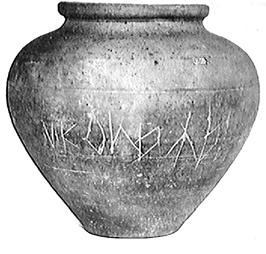
This is a typical urn that was
intended to hold cremated remains. Although there were a great number
of them, cermanics breaks easily and the number of complete sentences
is relatively small. Our methodology, which interprets words from
context in partial translations, can only use complete sentences.
Here are what I found on the cremation urns: Note that
the following represent ALL the complete inscriptions I found in my
sources for urns with the original Venetic alphabet inscriptions. The
methodology, which includes interpreting unknown words from partially
translated sentences, requires complete sentences and cannot operate on
fragments. (Fragments leave unknown portions that invite invention and
error) Nor have I left out poor ones. In scientific method, all the
sentences in the study must be dealt with. We do not use the 'trick' of
only showing the best ones. The translations are as literal as possible
in order to avoid the further 'trick' of making absurd meanings
seem poetic from poetic rewording. The words are translated with the
meanings that agree in all places they appear in the body of
inscriptions used in the study, and also the structure agrees with the
meanings of the grammatical elements in all places. (It would be silly
to reword these sentences into nice English form, as rewording is the
most common trick for deception and in effect can alter the translation
dramatically from its true meaning!! ) Thus I offer the most literal
translation I can achieve with English that correctly communicates the
thought. You the reader can imagine how an English speaker would
express the sentiment in modern English idiom.
The following translate the original Venetic
inscriptions. Urn inscriptions in the Roman era become more formal in
structure and use Roman conventions like using initials for repeated
words. We do not translate inscriptions from the transitional period
between the original use of Venetic and the final use of Latin due to
how it would have complicated the analysis and results. In our study we
first of all looked for the pure, original Venetic, mostly occurring
between 500-100BC.
“To go to the
heavens” ('heavens' in this case means the whole universe
overhead)
“Till, up to, the
vital energies” ('vital energies' I decided perhaps means
the white light, or the cremation fire seen in a positive manner)
“Until (new)
beginnings” (the idea that with death is the beginning of
a new state of existence in the afterlife)
“ Till earth/ash -
to reach”
(there remains a question of whether it refers to the urn being put
into the earth, or whether it refers to the deceased reaching the state
of earth=cremation ash. )
“In the direction
of the space-way”
(the word which 'space-way' translates appears to refer to the wide
open physical space above through which the deceased, in spiritual
form, journeys.)
“in the direction
of the gathering of conveyances - let remain”
(the word translated with 'gathering of conveyances' could refer
to several possibilities - the cemetary itself where the urns were
placed, or more abstractly the gathering of spiritual conveyances at
their destination in the heaven. More study of Venetic funerary
practices and sites may help make it clearer.)
“Ingratiations in
the direction of the oracle’s eternity”
(the word urkle is translated with 'oracle' because of similarity, but
in fact it appears to refer to the universe of the mysterious and
unknown that oracles deal with, based on what is suggested by Finnic uuri ‘investigate’ from which a
person doing so can be called uurik.
It is debatable.)
“In perished form
also in(to) the (new) beginning ” (the idea here is that
when a person dies/perishes, they enter a new beginning)
“From perishing,
into continuing on(??)”
(the same word seems to appear here as the previous for perishing, and
the whole sentence seems to express the same thought, although the
latter part uses other words.)
“the end (of
life)” (the
word for 'end, terminus' appears in other places too and resonates with
Finnic 'ot(s)' and is the only meaningful way a single word would fit
the context. Traditional analysts simply assume it is the name of the
deceased,)
“Go to heavens go”
(there is a duplication in two grammatical forms of the idea 'go', and
‘heavens’ is also eternity, etc)
Some of the results are more certain than others: It
depends on how much evidence was available to support a choice. For
example the most solid result of the above might be "To go to the
heavens" [v]oltio.m.nio.i.
because the meaning of voltiio
is very clear from other inscriptions and so is .m.nio.i. including the ending
being an infinitive.
The most uncertain of the above is “From
perishing, into continuing on(??)” .u.ko.e..n.non.s.
Here we see .u.ko
which appears in another sentence too, and our only way of determining
a meaning appropriate for an urn is by referring to Finnic ukko using
the meaning 'perish'. The meaning of .e.n.non.s.
is also unclear but at least other words suggest .e.n.no-
has a meaning related to conveying, shipping. Hence our proposed
meaning is 'into perish-transporting' or something like that. It is
suitable to the context of the urn with a cremation inside. This is a
good example of how the correctness is supported simply from the fact
it works very well, and that means if it is erroneous, the error is in
the nuances of meaning, and not in the general intent. (For example .u.ko- might
mean 'death' and that would work too.) Words with little supportive
evidence are much more open to debate in terms of details (if the
overall concept is consistent with the other sentences on similar
objects) and nuances of meaning.
You can study the actual analysis for all these
results in the project documentation
THE
VENETIC LANGUAGE: An Ancient Language
from a New Perspective: FINAL .
Note in the results that the Veneti gave each urn individual treatment
according to wishes of relatives and friends of the deceased. In this
early time there was no standard conventions as to what was put in the
text. In fact the adding of texts was in itself elective - most
funerary urns had no inscriptions at all. When we enter the Roman
era, the urn inscriptions begin to have a standard form, indicative of
influence from Roman conventions, before they are finally entirely in
Latin.
2.OBELISQUES
MARKING TOMB LOCATIONS
Past analysis that tried to force Latin onto the
inscriptions also had problems with the obelisques that marked the
location of tombs. Because it was an erroneous hypothesis, past
analysis could only claim the initial .e.go
meant
'I' so that all the inscriptions were little more than 'I am
[NAME]' Here too the same flawed method was used, of identifying
the Latin-like word and then turning the rest into a meaningless proper
name. I have already earlier commented on the lack of probability that
the sentence on a tomb could express that message. Thus the traditional
Latin based interpretation fails on two counts.
The obelisque inscriptions made sense if we allowed
them to express the eternal sentiment towards the deceased 'rest
eternally in peace' etc. This was possible if we allowed .e.go to be paralleled by the Finnic
jäägu
'let remain, let continue'. Here are the results from the obelisques,
bearing in mind that they are like tombstones, marking the location of
tombs: Once again the English is awkward in order to stay as literal to
the venetic as possible, including grammatical parallel. The reader can
imagine how the sentiment would be expressed in modern English. The
purpose for being literal is to be honest, as past analysis
(particularly by Slovenians) was all too keen to turn a result that was
absurd when taken literally into a seeming possible sentence from
poetic manipulation when converting into a modern language like English.
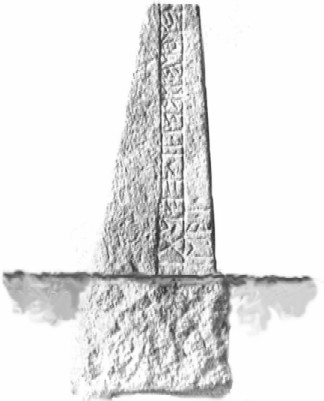
This is a typical obelisque that
marked tomb locations, showing how one end was buried into the ground.
It functioned much like later tombstones. Being visible to the public
they would have followed a standard pattern. All began with .e.go,
whose best meaning is 'rest, remain'. The traditional interpretation
with Latin ego 'I' is
completely wrong. Indeed even Latin iaco
is better.
“Let remain to
humble (oneself) in the eternal direction.” (The Venetic nerka
is interpreted with 'humble' but in reality it expresses the larger
idea of being weak-kneed and bowing towards something very powerful and
frightening)
"Let remain to go
to the heavens, to extend eternally to the infinite
direction”
('heavens', refers to the whole universe overhead, while other words
refer to eternity, infinity. I tried to be consistent in the English
word used for translation of a particular word to lessen confusion)
“Let remain
(endure, contininue, etc) , to disappear, till forever”
“Let remain, out
of being extending to forever extending”
(the use of 'extending' is only one way of trying to parallel in
English a complex, somewhat abstract, idea, that needs a poet to
interpret such as ‘Let remain, from out of existence, now extending,
extending forever’ But such poetic rewriting causes us to lose
the connection to the original Venetic structure.)
“Let remain
eternally towards the oracle’s forever’s beginnings.” (see
notes above for the urns for the meaning of the use of 'oracle')
“Let remain, to
the collection-gathering, towards the oracle-eternity” ('collection
gathering probably refers to the cemetary or tomb containing many urns.)
“Let remain
until ash/dust/earth , then up to eternity”
(very similar to one of the urn texts in last section. Finding the same
concept in both obelisques and urns but in different grammar and words
tends to confirm correctness)
“Let remain, to
carry, towards the sky extending”
(There are several ways in which the destination of the spirit is
expressed and here it appeared the word indicated a meaning of 'sky')
“Let remain, to be
conveyed, to the heavens go”
(whenever we translate with 'heavens'the Venetic word is voltiio, which
appears to refer to the entire physical universe overhead whereas words
like 'eternity' indicate abstract destinations.)
“Let remain, to
convey, to the direction of eternity”
It is very interesting to me that all these messages
refer to the journey of the spirit of the deceased to a destination
both in the physical universe above to where smoke rises, and to a more
abstract place at eternity - infinitely far away.. In general all these
sentences basically give the universal message humans have expressed
since the beginning of awareness of death - to wish the deceased have
an eternal sleep or rest. The sleep is physically on the earth, but the
spirit, it is naturally believed goes to the same place where we
experience dreams. Some people saw the new life occurring in the
dream-world.
Once you have developed a good sense of the Venetic
language from this investigation, one senses that the sentences on the
tombs are especially profound and poetic, each sentence essentially
with the same message, but each one attempting to say that same thing
in a unique new poetic way – to avoid repetition.
As with the urns, the certainty of these results
vary according to how much evidence there was. The most certain result
might be .e.go vo.l.tiiomno.i.
iuva.n.tiio.i
(literally) “Let remain to go to the heavens, to extend eternally
to the infinite direction” All the words in this
example occurs many times and cross-checking has given much certainty
to thier meanings.
The least certain of the above might be .e.go v.i.u.k.s.siia.i.
vo.l.tiio.m.min|na.i.
“Let remain, to be conveyed, to the heavens go” because it appears to
be in a slightly different dialect so we have to assume that v.i.u.k.s. is a variation of v.i.oug- and vo.l.tiio.m.minna.i. is equivalent
to vo.l.tiio.m.nio.i. This
dialect looks less palatalized and more like Estonian which uses viiuks
and minna. This suggests a colony from the southeast Baltic amber
route, not the one from the Jutland Peninsula.
The inscriptions on funerary objects above reveal a
great deal about the Venetic religious world view. They suggest
that the Veneti believed in an eternal afterlife. This should not be
surprising. The concept of death being an eternal sleep is very old
going back into prehistory. A dead person looks like they are
sleeping, but their breath has left, so they have gone permanently into
the dream world. This obvious concept is perhaps 50,000 years old.
3. THE
ROUND STONES OF PERNUMIA (AN ANCIENT ESTONIAN COLONY?)
The obelisques followed a formula that began with .e.go,
probably because they were visible to the public and at least needed
the repetition of the “Let be, remain, rest’ concept. The urns had
individual personal messages perhaps because they were not seen above
ground after being entombed - until the Roman period. But archeology
has found another group of inscriptions that seem very personal.These
were the round stones found at Pernumia near Padua, Italy. These stones
were apparently left on the bottom of tombs almost as if a last
personal message to the deceased before the tomb was closed up.
These inscriptions expressed their thoughts in many
ways, but all but one spoke more or less the same message - to command
the spirit to rise out of the tomb and journey into the infinite sky.
It was almost as if people had a fear that the deceased would be
trapped in the tomb, forgetting to leave the tomb for the freedom of
the infinite sky. The following is an illustration of one of the stones
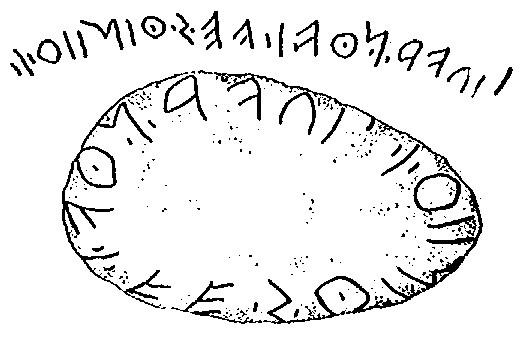
The texts were written on rounded
river stones and this is an example. Left at the bottom of tombs they
seem like a personal message left before the tomb was closed up, almost
all of them telling the deceased spirit to fly out of the tomb into the
heavens above.
The following are the messages on the round stones. We don't have
very many examples of these objects, but four of them
express the same sentiment in several different creative ways.
“In the infinite
direction would(?) conveying to eternity” ('would'
translates a word in which the verbal grammatical ending is unclear,
and this is an educated guess)
“lift from
the tomb into the open”
“To the clouds,
also up to the nation’s eternity”
“Onto wing, to fly”
The round stone that does not wish the deceased a
journey to infinity has one word 'to remember' The single word
inscription mu.s.ta.i. 'to
remember' looks like Finnish-Estonian muista.
All the sentences on the round stones resonate
remarkably with modern Finnic - Estonian and Finnish - and in fact the
place where they were found, today called Pernumia, strongly resembles
the province name Pärnumaa 'linden-land' for southwest Estonia.
The following two sound very much like a distortion of Estonian:
*Dividing the continuous sentence as following.
ho.s.ti
havo.s.t o.u.peio “lift from the tomb into the open”
This sentence when spoken out loud sounds like a
distortion of Estonian “Tõsta hauast
õu’e”
Similarly the following can only be translated from
its remarkable resonance with Estonian, beginning with the word
divisions as shown:
pilpote.i.
k up. rikon.io.i. “To the clouds, also up to
the nation’s eternity”
Spoken out loud, to the Estonian ear it sounds like “Pilvedele ka üles riigi-hii’u (=riigi-igavesele)” Note that the
parallelism in both is also in the grammatical structure. The only word
not in Estonian is u.p. for
'up', but that meaning is confirmed from other inscriptions that
show .o.p
clearly meant 'up'. . Estonian does not have this, but it is easy
to see how it could evolve from the opposite of PA 'on top of'.
See THE
VENETIC LANGUAGE: An Ancient Language
from a New Perspective: FINAL
. for much more discussion of these remarkable objects and their
inscriptions. I did not know what to expect. I didn’t expect that all
but one spoke of the deceased being told to fly up out of the tomb.
4.
LAGOLE -CALALZO
SAUNA FACILITY FOR MERCHANTS FROM THE SOUTHEAST BALTIC
One of the places in the Piave Valley appears, from the large number
of dippers and pots found, to have served travelling merchants coming
south from the amber trade route that began at the southeast Baltic (as
opposed to the route that came from the Jutland Peninsula). Previously
these traders headed to Greece but with the rise of the Romans, it
appears many began to turn west and come down the Piave Valley.
Since the sauna custom was well established in the Baltic culture, if
these traders/merchants came from the Finnic north, it is likely the
archeological objects describe a public sauna facility
Inscriptions are found on many of the dipper handles. These can be
studied in detail in THE
VENETIC LANGUAGE: An Ancient Language
from a New Perspective: FINAL
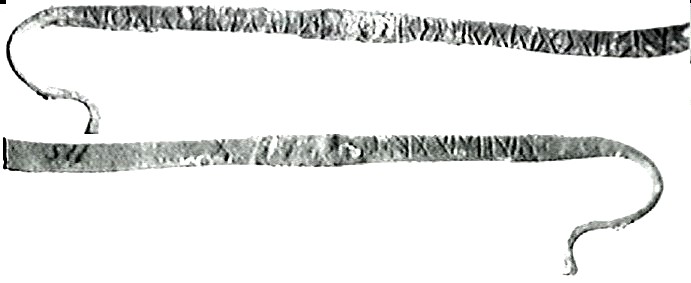
Example of dipper handle. The bowl part
of the dipper attached at the river holes have come off. This is the
kind of dipper that would have been used for throwing water onto sauna
stones.
These inscriptions date from the later Venetic
era into the Roman era. Most writing is in fragments and we cannot use
them since our methodology requires complete sentences to compare and
analyze. Thus there aren't very many to use from the early period with
proper Venetic, and most of the inscriptions are in compromised later
Venetic. Like the Roman era urns, we have to look at them separately
and be careful about using them to analyze the main body of
inscriptions,
The reason we present them here is because we
discovered something remarkable - they seem to identify professions
within what could be a public sauna spa facility (since dippers are
commonly used to throw water on hot stones in a sauna). But more
importantly the names of the professions or departments of the facility
translate easily directly with Estonian vernacular. The full sentences
state that these groups are identified with an object and offering to a
deity or lord called TRUMUSIA. We will only look at the names of the
professions or departments, the Estonian translation, and English
translation. Question marks indicate my uncertainty for some of them.
All come from the beginnings of sentences that end with 'offering to
TRUMUSIAT' (TRUMUSIAT, I interpret to be turu-maasejad
'those deities/spirits/lords of the market land' and a professional
deity for merchants coming through.) In the following, the Venetic is
given first, next the Estonian parallel, and the third the English
translation.
ke.l.lo.s. ossoko.s. -
kelluse osakuse - bell division
ke.l.lo.s.
pi.t.|ta.m.mniko.s. - kelluse
pidamisekuse - bell maintainers
voto.s.
na.i.son.ko.s. - vedese
naisekuse - water-women
ku.i.juta
. ametiku.ss. - kuivajate
ametikuse - dryers bureau
workers
suro.s. resun.ko.s. - (?)suure reisija (?) - (?)long-distance
traveller(?)
butijako.s. {- - - -]kos.
puidejaguse (?) - wood
distributing (?)
(Latin libertos ‘book’)
e.s.kaiva
liber.tos. a.rs. petija|ko.s. - eeskava-raamatu (libertos) haruse pidajakuse - schedule-book
division maintainer
aviro
bro.i.joko.s. - (?)
(?? Latin foveo, fovi, fotum - keep warm, maintain, foster.)
fo.u.vo.s
eneijo.s.
- ‘(??) inimesed’ - (?Fire-maintaining
?) people
fugene.s.
inijo.nti[kos - ‘(??) inimesed’- (?Furnace?)
people
fovo
fouvoniko.s.
-
(Latin applico ‘devote to’)
o.p.po.s.
aplisiko.s. õppuse
APLISIKUSE -
learning-devoted
futto.s.
aplisikos. tris’iko.s.
While a few were elusive, all of them
represent roles in a sauna facility, that by the laws of
probability simply cannot be random coincidences.
There is more evidence that merchants from the
southeast and perhaps even east Baltic who made trade journeys down the
more easterly amber route came down the Piave Valley as we enter the
Roman period, and that a dialect with more of the Estonian idiom is
found in the inscriptions found there. Furthermore, the Piave Valley
offers geographical names that suggest traders from the east Baltic set
up colonies to serve their people who were carrying wares back and
forth between the Adriatic and Baltic. But that is beyond the scope of
this short summary article.
5.
THE MYSTERIOUS
PRAYERS TO THE GODDESS AT SANCTUARIES
The most profound sentences in Venetic come from the sanctuaries where
the Veneti made offerings to their goddess. The goddess appears in the
inscriptions with the word re.i.tiia.i and past analysts have
interpreted the name of the goddess as "Reitia" However, our
study as described in THE
VENETIC LANGUAGE: An Ancient Language
from a New Perspective: FINAL
finds the goddess to be the eternal European mother goddess known as
"Rhea" who the Greco-Roman mythology made into one of their Titans and
she was the mother of the common Greco-Roman gods. The word re.i.tiia.i. by our analysis is
simply "Rhea" with a grammatical ending.
The inscribed sentences of dedication to Rhea appear
mostly on styluses and on a number of thin bronze sheets onto which the
texts have been pressed by styluses. I believe that the ritual at the
sanctuary was that a burned sactifice was made to the goddess, and then
the pilgrim wrote a message with the stylus onto a sheet of bronze. Not
all styluses had writing on it. Thus the writing on the stylus may have
represented another way of speaking to the goddess for those who did
not know how to write it. All the evidence suggests that both the
bronze sheet, the stylus, and any other gifts were left in a special
place accepting these items. It is possible that the objects left there
served to finance the operations of the sanctuary. Archeologists have
found plenty of styluses but not many bronze sheets. Some of the bronze
sheets appear to be practice sheets for practicing writing (see next
section). It is likely that bronze sheets were flattened again to be
reused, or they have simply disintegrated in the ground or been melted
for their bronze.
While the thin bronze sheets are few, archeology has
found a considerable number of styluses with a significant number
inscribed with the same kind of sentences that would be written onto
the bronze sheets.
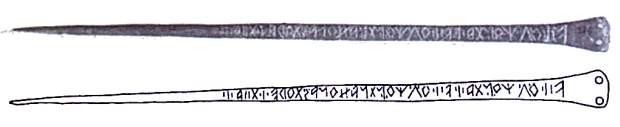
Example of a stylus (above) used to
inscribe onto bronze sheets
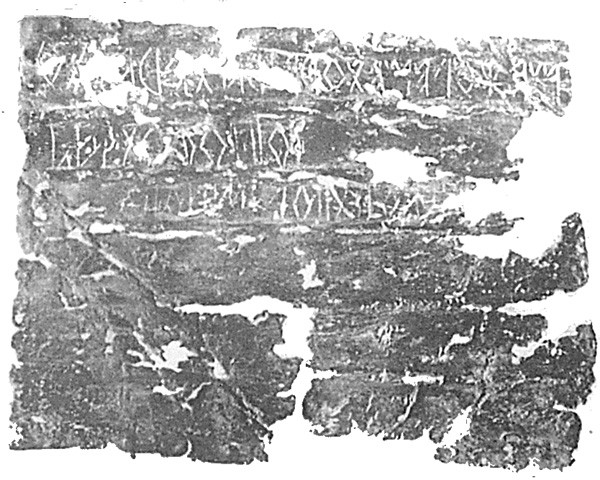
Example of a bronze sheet inscribed
on the top part. Archeologists have found very few of these - probably
because such thin bronze disintegrates in the earth. (Note the sheets
with the "OEKA" inscriptions - see below -, are not the same but were
obviously used to practice the alphabet and writing some sentences)
We know that our interpretations are correct when we tend to find
more or less the same sentiments expressed in them all, the repetition
of certain words, and the same grammatical structure. What we find is
that the pilgrim to the sanctuary has written something that addresses
the goddess, and appears to have been done in conjunction with making a
burnt offering to the goddess. In general, scholars have determined
that the Veneti followed a practice that was common in those days -
sacrificing farm animals to a deity. This word "sacrifice" has negative
connotations today but in fact it was how barnyard animals were
slaughtered for food. By dedicating the slaughter of an animal to
dieites, the slaughtering of the animal was made palatable even in
small households. After the ceremony, the meat was eaten in a
feast. (We find many examples of animals being "sacrificed" in a
ceremony instead of coldly "slaughtered", with a feast following, in
the Greek epic poem The Odyssey,)
The way something was transmitted to the deity was by burning it,.
so that the essence of it would rise with the smoke to the deity in the
sky. This was the principle in cremation too. But in animal sacrifice,
the importance of the meat as food prevented allowing fire to consume
the animal sacrifice completely. Often the innards were burnt for the
deity, and the rest then became a roast to be feasted upon. It was also
possible to burn inanimate things as offerings - such as burning of
grains from the first harvest, but only careful archeological evidence
chemical analysis will reveal what exactly was burnt.
Let us study some examples that reveal a little
about the practices at the sanctuary. Note that we identify the deity
as the universally known ancient mother goddess Rhea, which I believe
would have been written in the nominative case as re.i.a But the nominative
case does not appear in any of the inscriptions. What we commonly see
is a word re.i.tiia.i.
that translates as 'to Rhea' except that the 'to' has a complex meaning
that is analogous to how in modern religion we might say 'to unite with
god'. I found it was a dynamic usage of the partitive case.
I do not include below the sentences in
Venetic as my purpose here is only to demonstrate the results, as they
reveal a great deal about Veneti practices at the sanctuary and how the
goddess was addressed. For all the other details and more discussions
see the project documentation (THE
VENETIC LANGUAGE: An Ancient Language
from a New Perspective: FINAL )
Note again that the results are literal so as not to be
deceptive, and the reader is invited to consider how it would be
expressed in modern English
A.
INSCRIBED
ON SOME STYLUSES:
“I (we) convey, the
offering to Rhea as carryings endpurpose”
Comment: The
Venetic for this was difficult, and thus the certainty is not as good
as with some other ones. The final meaning that uses the idea of 'end
purpose' is inspired by what best fits the context.
“The collection of
conveyances, as ingratiation producers, remains”
Comment: The
'collection of conveyances' is our interpretation of v.i.o.u.go.n.ta see the study for
the complete rationalization of this and similar words. The v.i.ou-
words are very difficult because they seem to have assumed intricate
meanings connected with the rituals of making offerings. The idea in
this sentence seems to be that the pilgrims brought material gifts
which were left at a location where gifts were left. The gifts and the
location where they were left are a 'collection'. Our translation of
'ingratiation producers' worked everywhere it appeared. Its meaning
would be that the gifts, left at the sanctuary, continued to worship
the goddess after the pilgrims had left and gone home.
“Our brought
conveyance-collection as earth/ash/dust remains”
Comment: In the
context of making offerings to Rhea, the word mo.l.ta would refer to the ash left
over after the offering is burnt. There are other indications in other
inscriptions that mo.l.ta
referred to the remains of burning – including in the urns cremation
ash . But there might be some contexts in which it refers to returning
ash to the soil, or even the urn into the soil of the cemetery. This
interpretation implies that the conveyances that were brought were
things that were burnt, as opposed to gifts left at a collection site.
“To the
conveyance-collection, as conveyed-things, the offerings (things
brought) to Rhea”,
Comment: This
interpretation also seems to speak of a collection of gifts left at a
collection site.
“Our offering to
Rhea humbles as ingratiations-producer”
Comment: The
interpretation of one word as a verb for 'humble' was inspired by
Estonian and Finnish. The Venetic ne.r.ka,
would seem to be paralleled by Estonian nõrk, but today it means ‘weak’
but the parallel word in Finnish is ‘humble’ as required. The
translation above is literal, but the intention that the offering is by
way of showing humility through objects brought and left behind.
“Our
conveyances taken towards Rhea of the lords. Up to the heavens,
fly!
Comment: The tag
words 'up to the heavens, fly!' are certain as they occur in a similar
way in some other inscriptions. This message accompanies a sacrifice
and burning, as it expresses the wish that the spirit of the
sacrificed/burnt item travels up to the deity in the smoke.
“Convey the
offering as expression- of- wishes to Rhea”
Comment: This
interpretation expresses the typical sentiment in the messages.
“The conveyance up
to the place arising out of the vital fires brought to (unite
with) Rhea”
Comment: This and
the next interpretations struggled with a word beginning with v.i.re-
After many avenues of investigation I became convinced that this word
represented vital energy and could be compared to the bright light seen
at death - a positive energetic, bright place. In a culture that
cremated its dead, one had to see the cremation as a journey into a
positive energetic place - where the experience of fire was positive
not negative. This energetic place would also be experienced by a
sacrificed offering, and the goddess Rhea would also reside in that
place. See the project documentation for detailed exploration of this
subject.
“Up to (?) the
place arising from the vital fires, brought to Rhea”
Comment: Here I
identify the bright light at death as 'vital fires'. The sacrificed and
burnt item entering the vital fires is conveyed to Rhea.
“Our brought
[v.e.r.ko.n.darna ne.r.ka.i. m]”
Comment: This one
we did not translate because it clearly showed evidence of being in
another dialect of Venetic. We know from the other inscriptions
generally what it is about, but aside from noting the word ‘humble’
within ne.r.ka.i.m, I did not feel I should force a meaning on this one.
Our offering to
You, of the Gods, Rhea to turn (?)to
eternal something(?)...and towards the [ lo.u.de(?)]-way
Comment:
Unfortunately there are words here that do not occur anywhere else –
although the grammatical endings are clear – and with the information
we have we cannot translate – other than that we can make an educated
guess. I include this and the other difficult ones purely for the sake
of completeness (to stop critics who think that I am only presenting
the ones that were successful.)
“Our brought ...
to Rhea [bu.k.kakolia.i.(?)]”
Comment:
Unresolved as well on account of not finding a solution for . bu.k.kakolia.
“I convey the
conveyance, the offering, to Rhea of the oracles”.
Comment: This was
an easy one. The Venetic word URKLI I intrerpreted as 'oracle' a word
that was well established in the Mediterranean world. This word appears
to have referred to the realms of mystery and an oracle was a person
who consulted these realms of mystery. This inscription seemed to
regard the goddess as such a person - an agent of the realms of mystery.
“ Conveyances to
heavens-going, our offering to Rhea”
Comment: There was
some uncertainty as to grammar in this way. I interpreted it in a way
that made most sense.
“Carry the Roman,
the offering, to Rhea” (?)
Comment: I include
this too for the sake of completeness. This inscription looks like it
was written by a Roman who did not speak Venetic well, as we have a
good idea what it says, but the grammatical endings are off. The
interpretation above suggest what was intended.
“Our offering,
carry the Roman, to Rhea”
Comment: This too
showed bad grammar written by a Roman living in the Veneti colonies.
The intent is obviously that it is a Roman who is bringing an offering
to Rhea.
Untranslated
re.i.tiikatakna|lo.g.siiv.i.rema.i..s.tna
Comment. Because
the words . katakna lo.g.sii
remain unknown, it is not possible to produce a translation other than
that we see here again the re.itii
v.i.rema.i.stna we saw in a couple of places earlier.
“Our offering
convey to Rhea”
Comment: This too
had poor writing but the message was clear.
“Our offering,
conveyance and conveyance-collection to You of the Gods, Rhea.”
Comment: This too
appeared to have errors. I translated as I thought was intended.
” I convey carrying-going grouping
the offering to Rhea”
Comment: This is a
literal translation, and its peculiar form comes from the original
intending to describe the brought thing in new poetic ways, something
we have already seen several times.
I have listed all the complete inscriptions I found
in my sources for Venetic inscriptions - Manuel de la Langue
Venete,
by M. LeJeune While all these were inscribed on styluses, the
inscriptions were extra and not found on all styluses. Ordinary
styluses without inscriptions would naturally be used to write
similar messages on bronze sheets.
B.
INSCRIBED
ON BRONZE SHEETS :
Sadly
only one bronze sheet with a complete sentence was one used at the
shrine. The several others that were found were practice sheets with
the OEKA repetitions on them. The practice sentences on them,
however would be similar to what was written for real at the
sanctuaries. The first of the sentences below come from an actual
bronze sheet written upon at the shrine.
. “I(We?)
convey the conveyance our offering (lit. brought-thing) to
(unite with) Rhea as oracle”
The rest of the examples on the bronze sheets are
thought to be practice sheets because of the repeating of the letters
OEKA. We will explain the OEKA below, but first let us look at the
practice messages to Rhea that are found on the remainder of the
practice sheet. If it sounds awkward it is because the English is
placed in literal parallel
“Our offering
remains to liberate(?? uncertain grammar for v.i.aba.i. s’a) to turn up
in the direction of the eternal way”
Comment: There aren’t enough other examples of an
ending -a.i.’s’a to determine
what the grammatical form is, but there is evidence elsewhere that v.i.aba involves the idea of
liberation, freedom
“Our offering into
the sky-realm-going, in the eternal direction, into the
area-above, to You, eternal Reia”
Comment:
The translation 'area-above' is a little uncertain but conceptually it
must be close to what was intended.
“I
convey to the heavens-going our brought-thing and gift
to You of the gods, Rhea. Up to the heavens, fly!”
Comment: This translation is one of the most certain
ones. It is also one of those that confirms our interpretation of
certain words. Chances of it being incorrect are very small (for
reasons documented in THE
VENETIC LANGUAGE: An Ancient Language
from a New Perspective: FINAL
“Our
offering in the direction of ash which is also (via the smoke) to the
mountains-going to unite with Rhea.”
Comment: The intent of his sentence I believe
intends to contrast the act of the offering being burnt to ash and its
smoke rising up towards the Carnic Alps to the north. In ancient times
deities were associated with the heights of mountains.
“Our
ingratiation-producing expressions of energy(???v.i.ratere.i. ) as
offerings towards eternity to skyward-go”
Comment: This sentence is difficult in its
details because of the uncertainty of v.i.ratere.i. (other than v.i.re from other locations
referring to vital energy but we can infer the rough meaning from the
rest of the sentence.
“I convey
the offering (brought-thing) to Rhea, the energetic of the energetic.
Up to the heavens, fly.”
Comment: The most presumptious part of this
interpretation is to interpret a duplication of v.i.rema
with 'energetic of the (most) energetic' as a superlative description
of the deity Rhea (analogous to 'mighty of all the mighty' and that
kind expression found in ancient descriptions of kings, and emperors)
C.
OTHER
INSCRIPTIONS TO RHEA:
There are several more inscriptions dedicated to Rhea on other objects
- in this case columns with equestrian figures. Once again the
following are literal parallels. Our intent is not to show the
originals or discuss how they were analyzed but rather to study the
content for how it reveals the Venetic relationship to the deity Rhea.
If they sound awkward it is because they are in strict literal parallel
including word order and grammar.
“Our offering in
carrying to take to eternity’s beginning, to you, divine
Rhea”
Comment: This is a
quite reliable translation because the whole thing resonates so well
with Estonian, with all the correct grammatical parallels The
meaning is clear, the offering in carrying it, is taken to beginning of
eternity, where Rhea resides.
“Our into
forever offering in the direction of Rhea”
Comment: This can
be interpreted in another way too, with another word order. Note the
message is generally the same, but as human nature dictates the writer
will say the same thing in various other ways.
“In the direction
of ash also offering into no(?)”
Comment:
Unresolved. It is possible that the no word is an abbreviation. OR
there is no ‘and’ and the mystery word is kno.s.
6.
THE OEKA PRACTICE
SHEETS
Archeology has found a small number of bronze sheets at the Rhea
sanctuary where the bottom is scored into squares and the letters OEKA
are repeated over and over. At the end of OEKA is one of the letters of
the Venetic alphabet. The following is the best example because it even
seems to have a handle a student could use for carrying it.
A bronze sheet scored along the bottom
with the letters OEKA followed by one of the letters of the Venetic
alphabet. The writing on the top then is a practice message to Rhea.
The great mystery is in why is OEKA repeated
each time? Are these letters more common than any other? This is is a
question that has puzzled analysts for years, and there have been
several ideas. My own explanation, that is based on a presumption that
Venetic was Finnic, is that the repetition is a kind of educational
repetition. In education it is common to repeat, such as “2 times 2
equals 4; 2 times 3 equals 6 ; 2 times 4 equals 8; etc”. In Estonian
tradition it is common in studying the language to be attentive to the
‘correct way’ of speaking. Hence Estonian dictionaries and grammar,
have been fond of the terminology õige keelsus ‘correct way of
speaking’. Thus we can regard the letters OEKA as being equivalent to
Estonian õige ‘correct’. The
antiquity of this word seems to be affirmed by its strong
presence in Finnish too as oikea.
Perhaps the Finnish form can be seen to be the original form, and both
the Venetic and Estonian, are simplifications as in OIKEA > ÕIGE and
OIKEA > OEKA
At the end of each OEKA is one of the Venetic
characters. Thus what we see here is something analogous to the
Estonian ‘õige A, õige B,...’ translating as ‘The correct (way of
writing) A, the correct B, etc’
Finnish
|
Estonian |
Venetic |
oikea a
oikea b
oikea d
oikea e
- etc -
|
õige a
õige b
õige d
õige e
- etc -.
|
oeka a
oeka b
oeka d
oeka e
- etc - |
The purpose of the student writing OEKA before
writing each letter had the purpose of drumming the letters into the
student's memory in the fashion used by teachers since the beginning of
humankind.
This is only one of a great number of remarkable
coincidences that seem to connect Venetic with Estonian, the only
surviving language whose ancient speakers would have had direct
involvement in the north-south trade revolving around amber from both
the southeast Baltic where Tacitus found the Aestii, and Jutland Peninsula.
Another remarkable coincidence is described below:
7. THE PRESENCE OF RHEA
IN THE NORTH: ADDITIONAL EVIDENCE SUPPORTING NORTHERN ORIGINS
It is logical that if it is true that the
Venetic colonies were initiated by Finnic professional amber trader
families in the north at the two sources of amber - the Jutland
Peninsula and Southeast Baltic coast - then not only was the Finnic
language displaced southward but also other aspects of culture.
Religion is not easily replaced. We should therefore find the religion
found in the inscriptions also represented in the north. I will limit
our attention to the goddess, Rhea.
The Roman historian Tacitus wrote a geography of the
broad unorganized region of Europe the Romans knew as "Germania".
This only named the geographical region, and does not mean there were
many actual "Germans" there. The modern Germanic cultures originated
after the Roman Empire from a militaristic people in the highlands
south of the Jutland Peninsula. All other regions - regions that
depended on boats and harvesting nature - were ethnically of aboriginal
origins - Finnic.
The region of "Germania"
was arbitrarily defined by the Romans as the region from the Rhine to
the Vistula north of the Danube. Most of the region, Tacitus noted,
consisted of independent tribes that could be collectively called "Suebi"
because of cultural similarities, and perhaps speaking more or less the
same "Suebic" language. But when Tacitus reached the southeast
Baltic where he found Venedi on the Vistula, and Aestii along the coast, he noted
that the Aestii worshipped
"the mother of the gods"
. . .the Aestii nations ..... worship
the Mother of the gods. As the characteristic of their national
superstition, they wear the images of wild boars. This alone serves
them for arms, this is the safeguard of all, and by this every
worshipper of the Goddess is secured even amidst his foes.
(Tacitus Germania
ch 45)
To a Roman, 'the mother of the gods' was Rhea. When Greeks first reached the
Mediterranean via Mycenea, they found Rhea
and some other deities among the natives. So as not to offend the
original natives, Greek mythology turned Rhea and the other original
dieties into "Titans" and made Rhea into the mother of the deities that
were brought by the Greeks. This Rhea was a universal pre-Greek
deity, probably known all around Europe, her name spread by seafarers,
who Greco-Roman mythology inherited and hence to a Roman or Greek she
was the 'mother of the gods'.
We note that the Aestii were worshipping Rhea through
boars. This practice was not local to the southeast Baltic because
later in history Jacob Grimm wrote of a mythology of ‘The Boars of Freya’
and that in early Christian Scandinavia, everywhere across the
north, pigs were offered at Christmastime in the name of the
Scandinavian goddess Freya. Freya=Rheia? Obviously!
Those who want to claim the Aestii worshippers of
boars could not be identified with Estonians (Eesti) should learn that
the practice of sacrificing pigs continued in Estonia into the period
dominated by the Church. Their desire to do so was so intense that the
priests allowed the practice if it would be done in church cemetaries
dedicated to Saint Anthony, patron saint of pigs. In this way they
managed to extinguish the custom from its connection to Rhea
6.
THE
LANGUAGE:
SOME WORDS AND GRAMMAR
AND NEW SENTENCE CONSTRUCTION
A
SAMPLING OF VENETIC WORDS, GRAMMAR, AND CREATING NEW SENTENCES
The ultimate proof
that one has discovered Venetic is to have rationalized word stems and
grammar, and done it enough to be able to construct new sentences.
Our purpose here is to only offer a sampling of words and major
grammatical features, and therefore we will select from among the most
certain (with most evidence) words as listed in
THE
VENETIC LANGUAGE: An Ancient Language
from a New Perspective: FINAL
(words are selected more or less arbitrarily according to whim and ease
of introducing grammar and example sentences. The following
sampling becomes increasingly complex.
Note: An
asterisk* attached to a word, means it is reconstructed from the stem
and grammar information and we do not find it in the inscriptions.
o.p , up ‘up’ Because of
a tag phrase at the end of several sentences - .o.p voltiio leno -
and its suitable appearance in some other sentences, this meaning is
one of the most certain. This is one of the words that
demonstrate that Venetic does not originate from any modern Finnic
language (for example Estonian word for 'up' is üles) but from an
ancient west Baltic dialect. Nonetheless one can see how .o.p could
arise from reversing PA 'on top of'. We know that the meaning is 'up'
from the direct analysis of the Venetic. It is 100% certain.
vo.l.tiio (n)
‘universe above’ This interpretation is also quite certain from
our analysis of the evidence. I believe the meaning more
precisely expresses the general concept of ‘the whole universe
dominating everything above’. This word too has no Estonian or
Finnish direct parallel, but it could have arisen out of an ancient
interpretaion of what is now in Finnish valta, which means 'dominating'
This suggests vo.l.tiio arises
from the concept of 'universe' as 'everything that dominates us above'.
Here too, reference to modern Finnic only supplies indirect support.
This is clearly a word that developed in the west Baltic, Jutland
Peninsula, and the Germanic territories through which the Finnic
traders moved
mn-
(v)(verb stem) ‘go’ This is a certainty because of how it
appears. It exactly parallels Est. minna
'go' The following shows how it appears in a compound word
vo.l.tiio-mno.i. (v)(Compount
word in the Infinitive) ‘to skyward go’
GRAMMAR NOTES 1. (NOUN) : Nouns
consist of stems plus case endings or second parts of compound
words. In order to identify the nominative, we had to find the
word in several sentences so that we could identify the stem, hence the
nominative.. (For example vo.l.tiio
is probably a noun in the nominative, except that the doubling of the
i, which is seen a number of times in the inscriptions might be an
emphasis device expressing the idea of 'extreme')
leno
(v) (Imperative) ‘fly’ This word appears several times in sentences
where the meaning is obvious from context and additional language
evidence. This word is one whose meaning is fully supported by Finnish
and Estonian lenda
'fly'. But this meaning is strongly indicated by the end tag on several
sentences in which burnt offerings were sent up to the goddess - .o.p voltiio leno 'up to the
universe-above, fly!'
EXAMPLE NEW
SENTENCE (By making mn- 3rd pers. imperative instead of infinitive) o.p voltiIo mno* 'up to the heavens
go!'
.e.go (v) ( third person
imperative) 'let remain'. This word is very certain from
the context where it was used. In fact, we can find this verb
represented in other forms, for example:
.e.b (v) (third person present
indicative) '(he,she, it) remains, continues'.
GRAMMAR NOTES 2. (VERBS) Verb stems
are the same as the regular 2nd person imperative. Again the verb
stem was identified by observing the same word with different endings.
Whether it is a verb or noun can only be determined from context.
Ending for third person imperative: -go
Ending for third person present indicative -b.
Example 1. stem .e. 'remain; 3rd person imperative .e.go 'let remain', 3rd person
indicative .e.b '(he,she,it)
remains'.
Example 2. stem leno 'fly'; 3rd person imperative lenego* or lengo*; 3rd person indicative leneb* or lenob*
When a *
(asterisk) is added to the word, it means it does not actually appear
in the body of inscriptions and is reconstructed using knowledge of the
stem and case endings
va.n.t-
(n) ‘in the direction of’ (possibly ‘along with’) This is also
quite certain. In the body of inscriptions it appears with two
different endings: as Inessive vant.s.
and Partitive vanta.i.
It seems to be something like a preposition. The closest Estonian
parallel would be vastu, 'against' which is also a preposition that
takes a partitive.
GRAMMAR NOTES 3. (NOUNS.) A couple of major case endings:
-.s. Inessive or Illative depending on context
in sentence.
-(vowel).i. Partitive which translates in both a
passive (normal) way and a dynamic way that means 'become part of, unit
with'.
.i.io-, iio-, iiu- (n)
‘infinity’ is suggested by the context. Seems to have a fluid meaning.
Here the Venetic shows initial doted I as in .i.io-
it implies Estonian will have a J or H at front, and this resonates
with hiis which ,in recent history referring to a (sacred) grove, may
once have had a fluid meaning of ‘eternal place’ (place where souls
lived forever) and was abstract in character like a soul/spirit heaven.
iio.s.(n)
‘infinity, eternity' This meaning is one that tends to become
obvious in the Venetic use of a long I the more it is observed. It
happens to be reflected in the Finnic prefix iia and in Estonian hii-
GRAMMAR NOTES 4
(NOUNS): Creating names for towns and
objects from -st and -s This is revealed by the fact that in the
ancient Venetic colonies, the Adige River was called in Latin Atesis and the market at the nottom was
called Ateste. Elsewhere the
Piave River was called Piavis,
and the city today called Trieste was called Tergeste.
These reflect one of the ways in which ancient Estonian also created
names. For example silla- was a stem meaning 'bridge', and a town on a
river could be called Sillaste or Sillase. The -ste approach was
based on the Elative case ending -st which meant 'out of' or 'arising
from' and the -se approach was based on the Inessive case ending
meaning 'in -' Hence Sillaste meant '(town)arising from the
bridge' and Sillase was '(town) in the bridge location'. This
approach was also used for creating names of things out of descriptive
stems. For example in Finnic if veene meant 'connected with water' then
veenes meant '(object) connected with water=boat'. Using Estonian
parallels like ote 'end, terminus' and turg 'market', Atesis means 'in
the location of the terminus (of the trade route that went down the
Adige) and Ateste means '(town)arising at the terminus (of the trade
route) and Tergeste means 'town arising from the market'. The two case
endings involved are:: -st -
Elative 'out of' 'arising from' -.s.
Inessive 'in the place, form, location' ('into' if the
context expresses an active concept)
EXAMPLE
NEW SENTENCE lenob* .o.p
voltiio vanta.i iio.s. 'It flies up into the
universe-above in the direction of infinity'
iiuva.n.t- (n) ‘eternally in the direction of’ (‘eternally
along with’) This only adds a prefix, that from context, and other
usage of io, iio
means ‘infinite’. This interpretation like the above is largely
determined from how it is used in Venetic. This meaning fits well in
every location it occurs.
-ro- (n)
'way' This element, consisting of r+vowel is a very ancient and
fluid manner of saying 'way'. It exists in the ancient names of the
Rhine (Latin Rhennus) and
Rhone (Latin Rodanus) and
also at the ends of major trade rivers Loire (Latin Ligera) Wesser (Latin Vesera), Oder (Latin Otra), Volga (Latin Rha)
This usage is so old it is not just in Finnic and Basque, but also in
Germanic words for 'road'. It is so old it may have arisen in Europe's
proto-language.
bo-
(n) ‘in the direction of, to the side of’ is like va.n.t- (or iiuva.n.t), seems to be like a
preposition that can take endings. In the body of inscriptions, appears
with two endings, Partitive bo.i.
and Inessive bo.s.
The meaning is quite clear from direct analysis of the Venetic
inscriptions. It also appears as a suffix or in a compound word.
Example: iorobo.s. (see
examples below)
EXAMPLE NEW SENTENCES: lengo* bo.i.
iio.i. 'Let fly to the side of eternity' lengo* iiuva.n.ta.i. 'Let fly
in the infinite direction' , lengo*
iorobo.s. 'Let fly into the eternal way'
.e.ge.s.t.- (n) ‘the
continuation, the everlasting-to-come’ This word resonates with .e.go and the –st ending nominalizes it, creates a
noun. (see NOTES 4 above) Hence we see it as a derivation from .e.go or at least the stem .e. If .e.
means ‘remain’ ‘continue’ then a nominalization would mean ‘the
remaining, the continuance, the from-here-to-eternity’. The following
are two actual examples from the inscriptions:
.e.go
kata.i. ege.s.tna.i. ‘Let remain, to vanish, until
the forever-yet-to-come.’
.e.go .o.s.tiio.i
.e.ge.s.tiio.i. ‘Let remain, to infinite being, to
infinite continuance’
GRAMMAR NOTES 5
(NOUNS): Case
ending -na.i. 'up to, until'
This form is commonly called terminative and fund in Estonian as
-ni. This meaning is proven by this interpretation fitting all
places where it is used better than any other interpretation
Sometimes the ending is –ne.i.
: GRAMMAR NOTES 6 (VERBS) Infinitive:
while the verb stem is the simple imperative, the infinitive
requires an ending. I discovered that when verbs had an ending
(vowel).i. that the best interpretation was as the infinitive which is
in English expressed by 'to [verb]'. A real example would be kata.i. 'to
disappear'. By interesting coincidence this ending when
used on a noun, is also translated in English by 'to' - although
on a noun it is best identified with the Partitive case (see
above).
EXAMPLE NEW SENTENCE: .e.go leno.i.*
.o.p iiuvant.s. 'Let remain (continue) to fly into
the infinite direction'
kata.i.
(v)(Infinitive) ‘to vanish’ (stem kata*)This
meaning was vague until we decided it was parallel to Estonian kadu ‘disappear’ and it worked
perfectly in the context of the sentence when applied. (Another
Estonian word kata ‘cover’
did not work at all except that if you cover something it becomes
hidden. The –a.i. ending in
this case is the Venetic infinitive marker. The stem can be deduced to
be kata*
ke, k (Conjunction)
‘also, and’ appears several times in a manner where viewing it as
a conjunction similar to Est. ka
(‘also’) is the only possible approach. This is another certainty as
where it occurs we see parallelism.
EXAMPLE
NEW SENTENCE .e.b leno.i.*
bo.i. .i.io.s. ke kata.i. ege.s.tna.i. '(he,she,it)
remains/endures to fly to the side of infinity and to disappear until
eternity'
pora.i.
(v)(Infinitive) ‘to turn (self)’ Where this appears in the text
it fits the context ‘to turn towards the sky...etc’ It is
one of the 100% certain interpretations even before finding a perfect
parallel for it with Estonian põõra.
EXAMPLE NEW SENTENCE .e.b pora.i. .o.p iorobo.s.
'(He,she, it) remains, to turn up into the
infinite-way’
mego (n)
‘Our (my)’ The context had from the beginning
suggested to everyone traditionally from the Latin perspective
considering the word should mean ‘I’ or ‘We’ because of Latin ego.. The
context – associated with making offerings to a goddess at a sanctuary
– indeed accepts this interpretation. However, it is not
necessary to go with the Latin intepretation. The Finnic language of.
Livonian is relevant as it is highly palatalized like Venetic. Estonian
has meie, 'we'. for both
Nominative and Genitive, while Livonian has meg for the Nominative not
Genitive. Perhaps when meie
is highly palatalized it becomes MEIJE and then MEGE, but this is a
linguistic matter.. Nontheless Venetic appears to like an O ending alot
(I think on the Nominative) so MEGE becomes MEGO. Although Livonian
applies the meg only to the Nominative, we can still arrive at MEGO for
the Genetive if the Genitive is also originally MEIJE. In any
case, the context in which it appears seems to require mego be Genitive. I tried in many
ways to see if it might be nominative and it can’t because the
accompanying word dona.s.to
was found by comparative analysis in the inscriptions to be not a verb
but a noun (ie not something like ‘offer,donate’ but ‘the
offering,etc’) which it modifies. That mego
means 'our' or a formal expression of 'my', is so strong, we might as
well go with it
dona.s.to
(n) ‘the bringing, something brought’ Traditional analysis of Venetic
by any other theory, will invariably determine from context that this
word means someting like ‘offering, donation’. I agreed it had to
be something like this, but my analysis found it to be nominal not
verbal.and that the verb form was simple do- 'bring'. The lengthy deductive
process is too lengthy to discuss here. It and the expression mego dona.s.to ..'s'a.i.nate.i. re.i.tiia.i
is discussed at length in
THE
VENETIC LANGUAGE: An Ancient Language
from a New Perspective: FINAL Note the
ending -.s.to arises in the manner described in Grammatical Notes 4
above.
do* (v)
(imperative and stem) 'bring' This imperative form does not
appear in the body of inscriptions but it was probably as common as
today in Finnic the command 'tuo!'
or 'too!'
la.g.s.to
(n) 'gift' This word appears in parallel with dona.s.to and that
parallelism proves not only the correctness of the interpretation but
also our deduction that both dona.s.to
and la.g.s.to are nouns. Both
are new objects derived by applying -.s.to
on a more basic stem. In the case of la.g.s.to the stem is la.g.- In this case we knew
the meaning would be similar to dona.s.to
and decided on the detailed meaning from Estonian lahke 'generous' and lahkustus 'gift'. (Note many times
when Venetic shows dots, the Estonian parallel will show an added H.)
re.i.tiia.i.
(n) (Partitive) 'towards union with Rhea' . The stem reia* (n) 'Goddess Rhea' Does
not appear in the inscriptions. We determine it from removing the
endings from re.i.tiia.i..
Note as discussed in THE
VENETIC LANGUAGE: An Ancient Language
from a New Perspective: FINAL the t is
introduced for phonetic reasons - to break up a long accumulation of
vowels.
te.i. (pronoun)
'to You' This is quite certain and resonates with Finnic.
When compared with mego 'our', it suggests there was also a tego* for 'your' and me.i.* for 'to us'
GRAMMATICAL
NOTES :(NOUNS) mego is irregular. The only other personal
pronoun in the body of inscriptions is te.i. which is 'you' in the Partitive. We can
infer that there could have been a me.i.
GRAMMATICAL NOTES :(VERBS) Past Participle appears to be give by the
ending -to or -tu For example doto
appears several times, and translates well as 'brought'. A summary of
word endings so far given in the Grammatical Notes above, using the
stem do: do! 'bring'. do 'go* 'let bring', dota.i.* (added t,d to break up long
series of vowels) do.b. (he,she,it)
brings.
EXAMPLE NEW SENTENCES: do.b. mego dona.s.to ke
la.g.sto re.i.tiia.i.
'(he,she,it) brings our brought-thing and gift ; tego* dona.s.to ke la.g.sto
lengo* iiuvant.s. iiorobo.s.
ke kata.i. .e.gestna.i. re.i.tna.i.*
'Your brought-thing (offering) and gift let fly in the eternal
direction into the eternal way and vanish until eternity and until Rhea.
ka.n.ta.i.
(v)(Infinitive) ‘to carry (bear)’ This word is one that Finnic
suggests is most appropriate when something is carried on foot, as
opposed to carried by water.. (Est. kandma)
vo.t.te.i.
(v)(Infinitive) ‘to take’ This word is one that Finnic suggests
is most appropriate when something is taken (Est. võtma)
v.i.(o)u-
(v) ‘carry, convey’ This is the stem for several words and Finnic
suggests it originated from a verbalization of 'water' and meant 'carry
by water'. . The infinitive form does not appear in the
inscriptions but it might be v.i.a.i.
or v.i.o.i.
.u.pos, .o.pos noun 'horse' This word is quite
certain because it occurs in two sentences where a picture or
context suggests involvement of a horse or horses
.e.cupetaris
‘happy journey!’ This is an end tag found on memorials that shown
people in chariots going someplace. The memorial celebrates the
departure. Perhaps there was great festivity celebrating departures.
The first part .e.cu is
clearly the same as .e.go,
with g becoming harder among the hard consonants P, T
rako (n)
'duck' A certain word -see discussion earlier
pueia (v)
imperative 'catch (him, her, it)
EXAMPLE
NEW SENTENCES: .o.pos ka.n.tab
la.g.sto .o.p kara.i. - .e.cupetaris 'the horse
carries the gift up to the mountains - bon
voyage.' pueia rako.i.!! 'catch the
duck!' rako .o.* la.g.sto kanta.i. pupone.i.
'the duck is a gift to carry to the Father' (There is reason to believe
that .o. is third person
singular for 'be')
This is only a sampling of words, significant grammatical features, and
example sentences to demonstrate that the methodology was able to
decipher Venetic enough that it is possible to create usable new
sentences from what was determined.
There are an equal number of further words in the lexicon and an entire
chapter of grammar in THE
VENETIC LANGUAGE: An Ancient Language
from a New Perspective: FINAL There is also a
paper that summarizes the grammar that you can consult.
7.
SUMMARY:
IF IT LOOKS AND QUACKS LIKE
A DUCK
The problem we face, even if the inscriptions
have been translated well, is that archeology has revealed only less
than 100 complete usable sentences, Our vocabulary is limited. In
creating new sentences above, I would have loved to have more common
everyday words. What are words for 'man', 'woman', 'walk', 'run',
'speak', and so many more everyday words needed to create common
senences? It is frustrating to be limited to the sentences used
for bowing to Rhea, or saying goodbye to the deceased. If Venetic
is Finnic as the examples seem to confirm, it is possible perhaps to
borrow words from Estonian or Finnish, that linguists determine existed
in the Venetic times. In this way a pseudo-Venetic could be
developed.
But the purpose of the project documented
in THE
VENETIC LANGUAGE: An Ancient Language
from a New Perspective: FINAL
was only to determine what the Venetic inscriptions say, when
interpreted properly in the traditional way -such as how code is
deciphered from direct study of the language - instead of the
traditional silly approach of trying to 'hear' Latin, Slovenian,
etc in Venetic sentences and forcing the sentences into strange
and absurd meanings that are far from what the actual archeology
suggests.
All previous attempts to decipher Venetic have been
pursued by first making a hypothesis of linguistic affiliation. For
example one proposes Venetic was "archaic Latin" or "Latin-like archaic
Indo-European" or "archaic Celtic" or "archaic Slavic/ Slovenian"
.... and then tries to listen for meaningful sentences in those
proposed languages in the inscriptions. This is a testing-a-hypothesis
approach. Hypotheses, as any scientist knows are tested and if the
testing is not successful rejected. Unfortunately because the testing
involves a large investment of time and effort, anyone who pursues any
such hypothesis is unlikely to admit failure and admit "The results are
not adequate and chances are high that the hypothesis is wrong and I
have wasted years of my life". Instead each hypothesis gets a following
that becomes sometimes fanatical about defending the hypothesis. As
long as the results of the trial-and-error approach is poor from any
hypothesis, all trial-and-error results are equally poor, equally
rejectable.
Realizing this, I knew that the past approaches did
not work. If I assumed Venetic was Finnic, and tried to hear Estonian
or Finnish in it, that would simply add a further language into the
battle between hypotheses. That is when I looked at how traditionally
ancient unknown writing was deciphered - having at least a few
translations to achieve a few CERTAIN words. If even a handful of words
was taken out of the realm of imaginings, that would give an anchor of
certainty. What could we learn from the Venetic inscriptions
without any a priori hypothesis? So my methodology became one of
finding the simplest inscriptions and discovering meanings suggested
directly from the context. And then we began looking for confirmations
in Finnic. In this approach, as I explained above, we are not forcing
any hypothesis on the Venetic sentences, but allowing the Venetic
sentences reveal themselves and then apply the hypothesis. Instead
of "hearing" Finnic in Venetic, we find solutions first and then try to
"hear" Venetic in Finnic. The reverse approach! Scholars
are free to try this approach with other languages, but because Finnic
words and grammar produced extraordinary parallels, it is quite
unlikely that a non-Finnic language will come even close in terms of
getting results.
The proof is in the results (see THE
VENETIC LANGUAGE: An Ancient Language
from a New Perspective: FINAL
for the full project document) and the following saying
applies: "If it looks like a duck and quacks like a duck, it probably
is a duck."
Those who find some of the above a little
questionable should note that this article is a great condensation of
the contents of the full documentation in THE
VENETIC LANGUAGE: An Ancient Language
from a New Perspective: FINAL
. In the above brief introductory article we have carefully
selected examples and explanations that can be easily absorbed by
readers who hopefully have a general scholarly education and
experience, but know very little about the Venetic inscriptions or even
the issues around the deciphering of ancient incriptions. Those
who have questions need only refer to the full documentation contained
in the book, but note that to fully understand the subtleties of the
project, it is advised the reader follow the book carefully in sequence
from beginning to end, as the book is constructed in the same way one
teaches any language - starting with the simplest ideas and gradually
becoming more complex. Anyone who does not follow the documentation in
sequence from the beginning would be analogous to, for example, opening
a textbook of the French language in the middle and expecting to be
able to understand it. One cannot grasp any language of any kind
without learning it in sequence from simple to complex. Note that,
since it is in the character of learning a language that it becomes
increasingly easier, anyone who seriously tries to understand the
contents of the book, in sequence, will find progress becoming
increasingly easier, as in learning any new language.
REFERENCES
The above article is a simplified
summary of the project and results documented in THE
VENETIC LANGUAGE: An Ancient Language
from a New Perspective: FINAL
(2013) and anyone who has developed further interest should access the
full account of the project, located by clicking the link. The images
above come from that writing, which in turn came from a major 1960's
documenting of Venetic inscriptions - La Lingua Venetica by G.B.
Pellegrini and A.L. Prosdocimi . The sentences used in the study and
the way of writing them with normal Roman alphabet plus dots, came
ultimately from Manuel de la Langue Vénète 1974, by M.
Lejeune in in 1974
2014 (c) A. Pääbo.